
+70
°
F
+74°
+58°
Niagara Falls
Thursday, 16
See 7-Day Forecast
Featured News - Current News - Archived News - News Categories
Press Release
A deadly disease called “oak wilt” is poised to invade Western New York.
While millions of oak trees have already been killed in the Midwest, the threat to our local oak trees is inching closer by the day. Oak trees just across the river in Niagara Falls and Niagara-on-the-Lake, Ontario, have already been infected, making trees on this side of the border in Lewiston, Youngstown, Niagara Falls and Grand Island the most vulnerable to the fungal disease. Moreover, the New York State Department of Environmental Conservation has expanded emergency orders to contain the disease in Yates and Ontario counties, just south of Rochester.
Lee Simonson, owner of Saving Oaks (SavingOaks.com), a Lewiston company dedicated to providing preventative tree vaccination services, said, "Oak wilt disease is on the horizon, literally. When it hits, it will most likely come from Ontario with the pathogen carried across the Niagara River by sap beetles. Like any contagious human disease, one tree will get infected and then nearby trees through interconnected root systems, with beetles amplifying its spread. The fungal disease is deadly to red oaks, including pin oaks, with no known cure. White oaks show greater resistance but often struggle to recover, if they recover at all."
What can one do to save high-valued oak trees?
•First, don’t prune or trim oak trees until late summer or fall. If a tree has to be pruned, or if it has been hit by storm damage, be sure to coat the wound with a prune sealer or latex paint immediately. Sap beetles can smell fresh, exposed wood several miles away.
•Second, if one has important oak trees on their property they want to protect, consider having them professionally vaccinated. Trees should be vaccinated every two to three years until the threat has passed. Vaccinating oak trees can be more cost-effective than potentially paying thousands of dollars to cut down mature trees that have died and removing stumps. Vaccinations start when the leaves come out in the spring.
Providers using special fungicides must be licensed by the state. For more information, email info@savingoaks.com.
•Third, don’t purchase firewood that has been imported from other counties or states. While oak wilt cannot be transmitted by burning infected firewood, fungal mats can form on unseasoned red oak firewood. Therefore, it’s best to get wood locally that has been completely dried for at least one year.
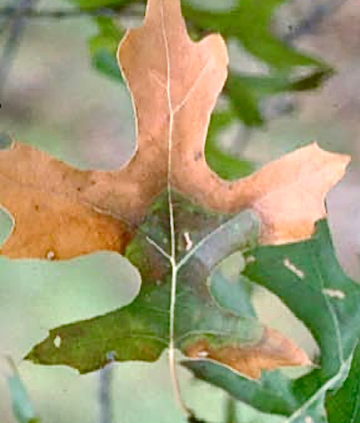
•Fourth, be on the lookout for tree symptoms. Leaves prematurely falling from the tops of trees with no color on their tips and outer edges is a telltale sign. Another indicator is vertical cracked bark that emits a sweet, fruity smell. Those who suspect an infection can call or text Saving Oaks at 716-273-5522 with photos. Information may be shared with local extension agencies and the state forestry service.
“Our Dutch elms were wiped out in the ’60s, and people will remember the thousands of ash trees we lost over the past few years because of the emerald ash borer. The same thing can happen with our precious oak trees,” Simonson said. "Unfortunately, unless precautions are taken, people, businesses and local governments will be spending millions of dollars removing dead trees. Our mission is simple: Protect our trees, keep oak wilt out of our region, and promote a healthy biodiverse ecosystem."




















1859 Whitehaven Road, Grand Island, NY 14072
Phone: 716-773-7676
Fax: 716-773-7190