

+70
°
F
+74°
+58°
Niagara Falls
Thursday, 16
See 7-Day Forecast
Featured News - Current News - Archived News - News Categories
Article and Photos by Benjamin Joe
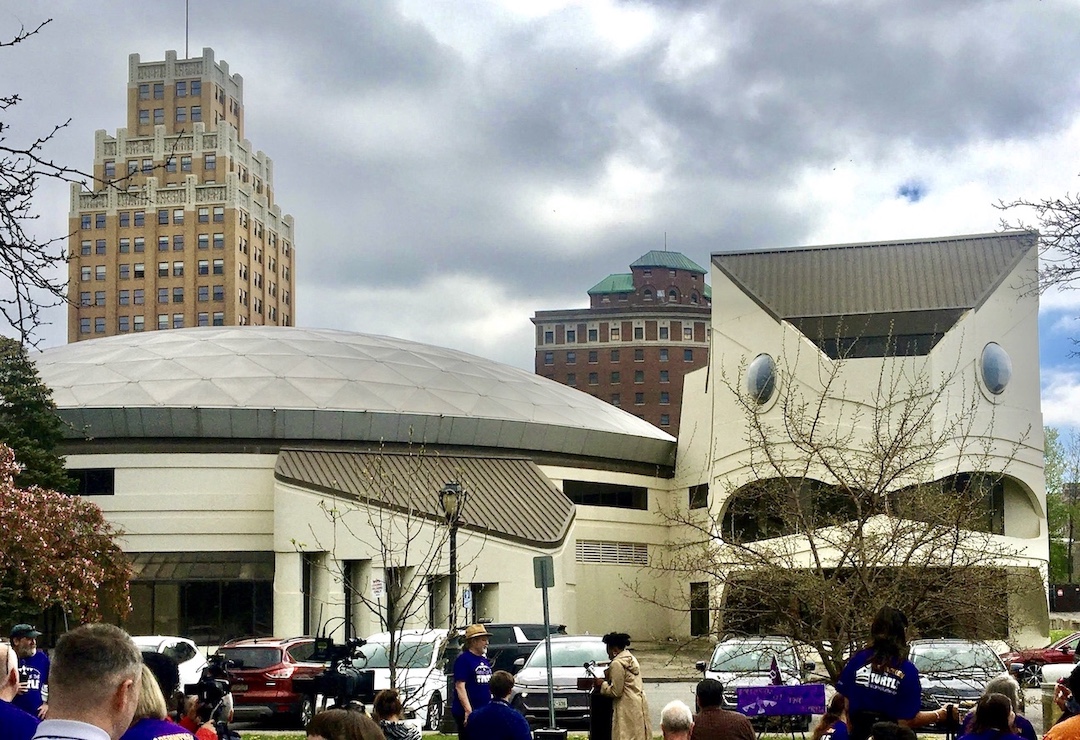
Approximately 40 people gathered in Cataract House Park directly across the street from the Turtle Building, on 25 Rainbow Blvd., to create awareness of the importance of this structure to the Haudenosaunee people.
The gathering was organized by the group Friends of the Turtle, which called for the vacant building to once again be opened for dance, Indigenous crafts, and other cultural events sacred to the six Native American tribes that make up the Haudenosaunee.
Group members Jennifer Touchine traversed with almost 30 people on a brief walk ending at the Turtle Building before speaking with this reporter.
She said the building has been vacant for 30 years – since it was bought by a private developer with the intention to demolish the Turtle and build a high rise.
Luckily, the airspace was not available, Touchine said, and so the building was not destroyed, but has been left to rot.
While the group has tried to find a way to buy the building and restore it, she said the owner is “not in the business of selling buildings, just development.”
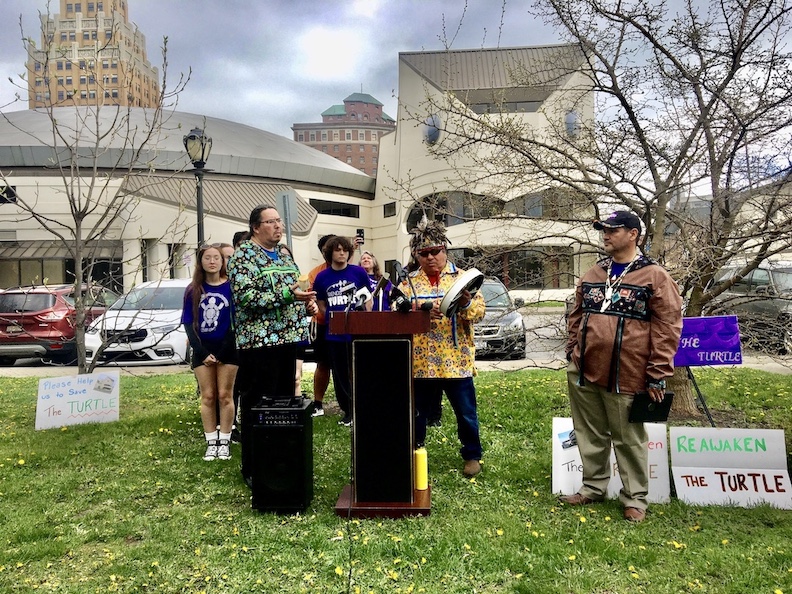
But the battle is not over. At the gathering, which drew television camera crews, Friends of The Turtle Board Chair Shaun Wilson introduced Di Gao, the senior director of research and development of the Natural Trust for Historic Preservation.
“The National Trust is a privately funded nonprofit organization that has led the movement to preserve America’s historic places for the past 75 years,” Gao said. “We believe in the power of place. The preservation of places that matter to communities allows us to honor the stories, events, people and places that define us as a nation. I’m joining you here today to announce that the Turtle has been named to the 2025 list of America’s 11 most endangered historic places.”
The significance of the naming is good news for the Turtle and those who want it to keep it standing.
James Baptiste, vice president of the Friends of The Turtle, who is also an architect, commented on the designation’s significance. He said the National Trust “will be bringing national attention to the Turtle,” as well as the struggle to get it opened again.
Doh-Bid Pierce, of the Seneca, Hawk Clan, sang a new song about the Turtle in the native tongue at the gathering.
He said the last time he was in the Turtle building was 1988. There was a pow-wow inside on the hardwood floors of the three-story building within the structure’s shell. He noted how the building had fared without attention.
“You can see the water damage on the corner there,” Pierce said. “That was allowed to drip into the walls and the drywall.”
But the bones of the building’s beauty are still there. Baptiste noted the geo-roof of the shell is made of eagle-shaped skylights, and hardwood floors had taken the beating of many dancers. While he has not been inside, he said he believed they are still useable.
Baptiste also said buildings are usually thought of as “structures” without a lot of sentimentality.
“It’s rare for a building to mean so much to a people,” he said.
More on The Turtle
Friends of the Niagara Turtle shared a quote from Carol Quillen, president and CEO of the National Trust for Historic Preservation. She said. “As we approach the 250th anniversary of the United States, we must acknowledge and support the Indigenous history that has so often been hidden and forgotten. The plans to ‘reawaken’ the Turtle would provide exactly the celebration of tribal heritage and culture that we need more than ever.”
The group further noted the Turtle is an iconic building designed by distinguished Northern Arapaho architect Dennis Sun Rhodes. The three-story zoomorphic building has 67,000 square feet, with eagle skylights, a geodesic dome roof “shell,” and large porthole “eye” windows – invoking the Haudenosaunee creation story of the earth forming on the back of a giant turtle.
For 15 years, the Turtle served as a cultural center for the Native American community. It was the largest center for Indigenous arts in the Eastern U.S. Representatives from the Smithsonian Institution visited the Turtle and incorporated some of its features into the design of the Museum of the American Indian in Washington, D.C.
The Turtle closed to the public in 1995.
Friends of the Niagara Turtle is a local, community-based nonprofit group formed to promote landmark status for the building and to bring together interested parties to “reawaken the Turtle” as a viable Native arts and cultural center. The coalition includes Indigenous representatives, including the only indigenous architect in New York, museum professionals, historic preservation specialists, tourism promoters and scholars.
Prior to the announcement, the Friends of the Turtle sponsored a walk along the Niagara Gorge.
The National Trust for Historic Preservation is a privately funded nonprofit organization that works to save America’s historic places.













1859 Whitehaven Road, Grand Island, NY 14072
Phone: 716-773-7676
Fax: 716-773-7190