


+70
°
F
+74°
+58°
Niagara Falls
Thursday, 16
See 7-Day Forecast
Featured News - Current News - Archived News - News Categories
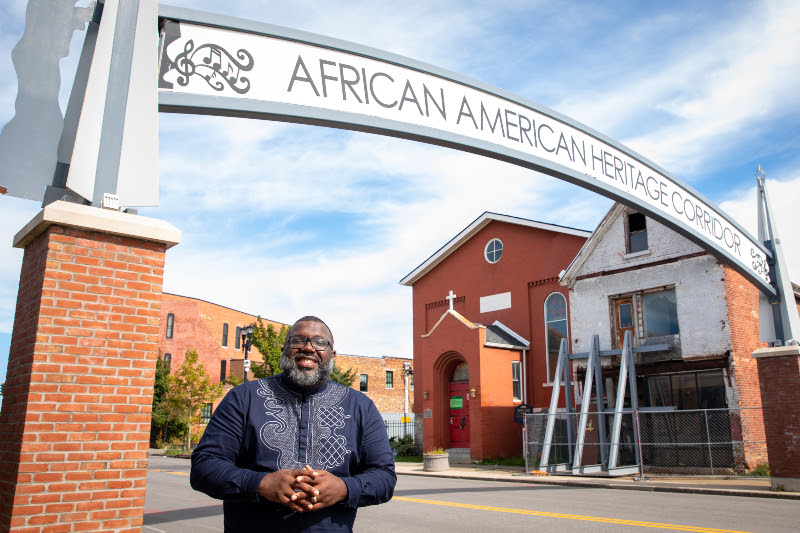
By the University at Buffalo
What began as Negro History Week in 1926 has evolved into Black History Month, now approaching its 100th anniversary. As the milestone nears, a University at Buffalo scholar is encouraging renewed reflection on the origins of the observance and the work that still lies ahead.
Scholars, including LaGarrett King, director of the Center for K-12 Black History and Racial Literacy Education in UB’s Graduate School of Education, credit Carter G. Woodson with the creation of Negro History Week and its eventual expansion into Black History Month.
“Woodson’s groundbreaking work made Black history visible, accessible and integral to the nation’s story,” King said. “His vision established a tradition of celebrating and preserving the legacies of Black people who shaped the nation.”
Woodson, the son of formerly enslaved parents, worked on farms and in coal mines before earning degrees in higher education. In 1912, he became only the second African American to earn a Ph.D. in history from Harvard University.
February was intentionally chosen for the observance to align with the birthdays of Abraham Lincoln and Frederick Douglass, King said, noting that Black communities had already been commemorating Douglass since the late 19th century.
“Using February allowed for a seamless transition and expanded the celebration beyond college campuses to include schoolchildren and the broader public,” King explained.
Although President Gerald Ford formally recognized Black History Month in 1976, King emphasized that the expansion from a week to a month was already underway years earlier in Black communities, schools and universities. One of the earliest monthlong observances took place in 1970 at Kent State University, organized by the Black United Students.
While federal recognition brought national visibility, it did not create curriculum requirements. Today, Black history education varies widely across states and school districts.
“Educators continue to miss the mark when teaching Black history is limited to slavery, Reconstruction and the Civil Rights Movement,” King said. “When instruction is disconnected from the present, students are left with fragmented understandings of how history shapes contemporary society.”
King noted that many educators are seeking improved approaches through organizations and resources focused on Black history instruction, including his own teaching Black history principles, which have been adopted by teachers and school districts nationwide.
As the 100th anniversary approaches, King said the moment is both celebratory and instructive.
“I feel proud,” he said. “I don’t know if Carter G. Woodson imagined Negro History Week growing into something this enduring, but its longevity speaks to his vision and to the determination of Black communities who sustained it.”
Amid ongoing political debates surrounding diversity, equity, and inclusion initiatives, King remains optimistic.
“We do not need permission to celebrate history,” he said. “Black History Month exists because the people created it, and it will continue as long as the people sustain it. That gives me hope – even during challenging times.”




























1859 Whitehaven Road, Grand Island, NY 14072
Phone: 716-773-7676
Fax: 716-773-7190