


+70
°
F
+74°
+58°
Niagara Falls
Thursday, 16
See 7-Day Forecast
Featured News - Current News - Archived News - News Categories
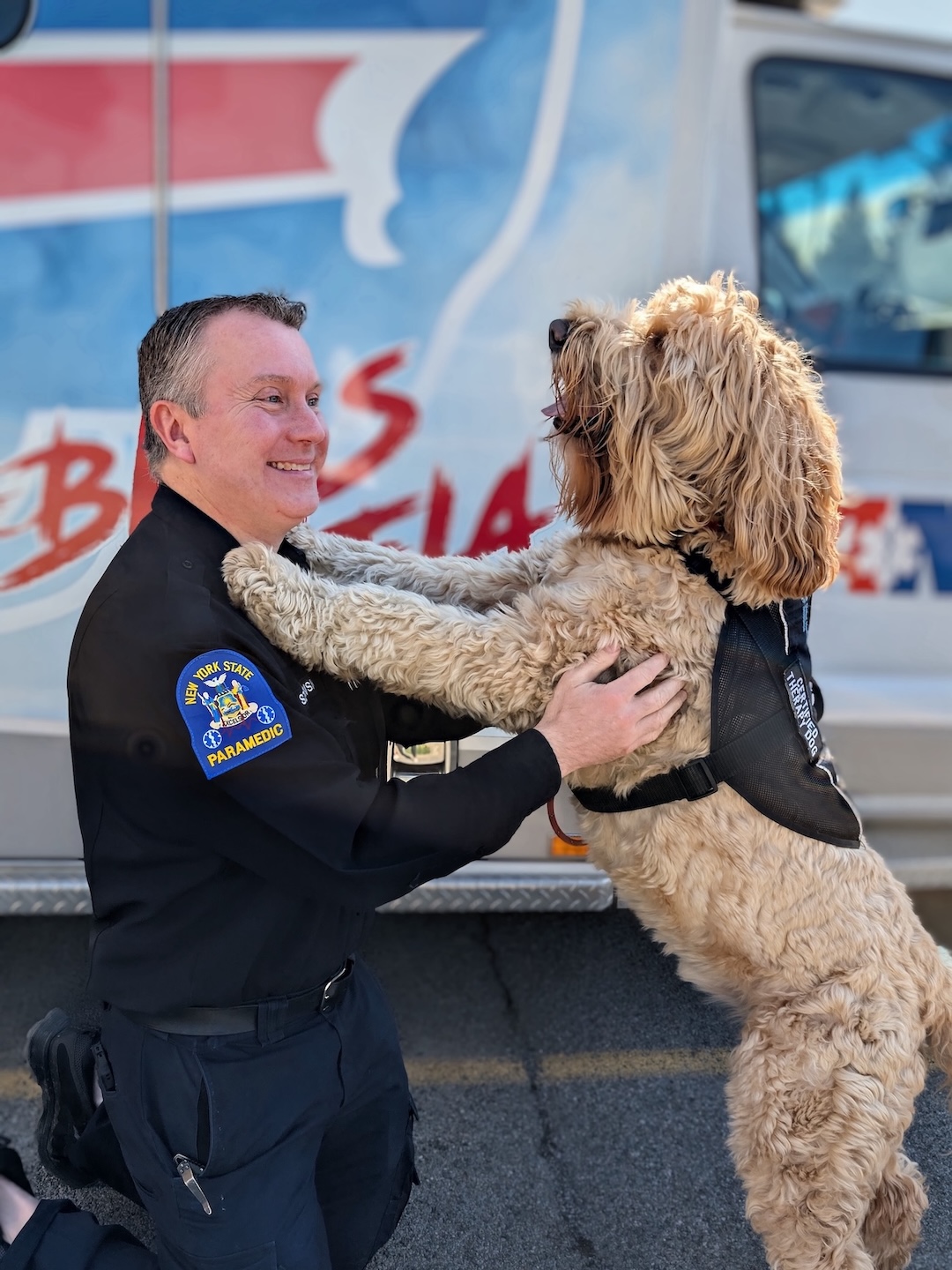
Therapy dog helps EMS crews navigate weight of job
American Medical Response press release & photos
Not every moment in emergency medical services (EMS) can be talked through. Some moments stay with you. Others build quietly over time. And not every provider processes those experiences the same way – or wants to talk about them at all. For many EMS professionals, support doesn’t always come through conversation. Sometimes, it comes from a goldendoodle named Rosco.
“He gives people a way to release stress without having to say anything,” said Scott Karaszewski, chief EMS officer and Rosco’s handler and partner. “Not everyone wants to talk about what they’ve seen or experienced. Roscoe gives them another way.”
Rosco, a 5-year-old therapy dog with American Medical Response (AMR) Western New York, a Global Medical Response (GMR) solution, is part of the GMR therapy dog team, a national program supporting the mental well-being of first responders. Across Western New York, he supports EMS crews through moments that don’t always have words.
A different way to show up
Rosco has been part of the therapy dog program since he was just 10 weeks old, becoming fully certified two years ago after completing multiple Canine Good Citizen (CGC) training programs, including advanced and urban certifications and a final therapy dog evaluation. His path into the program wasn’t planned – it came down to timing.
“There’s usually a waiting list,” Karaszewski said. “When we found out a puppy was available, we took the opportunity. It just worked out.”
From the start, Rosco showed a natural ability to connect with people – something that can’t be trained. Since then, he’s become a familiar presence among crews, known not just for his size, but for the way he moves toward people who need him most.
Meeting people where they are
There is no set schedule for Rosco. His days are shaped by what the people around him need. He visits EMS crews, checks in during shifts and spends time with students in the Earn While You Learn (EWYL) Academy – often showing up during skills training and testing, where stress levels are high.
“He has a way of being there at the right time,” Karaszewski said. “Especially when someone doesn’t even realize they need it.”
In the community, Rosco’s role continues. At events, he quickly becomes a focal point, especially for children, drawing them in for interaction that feels simple but meaningful.
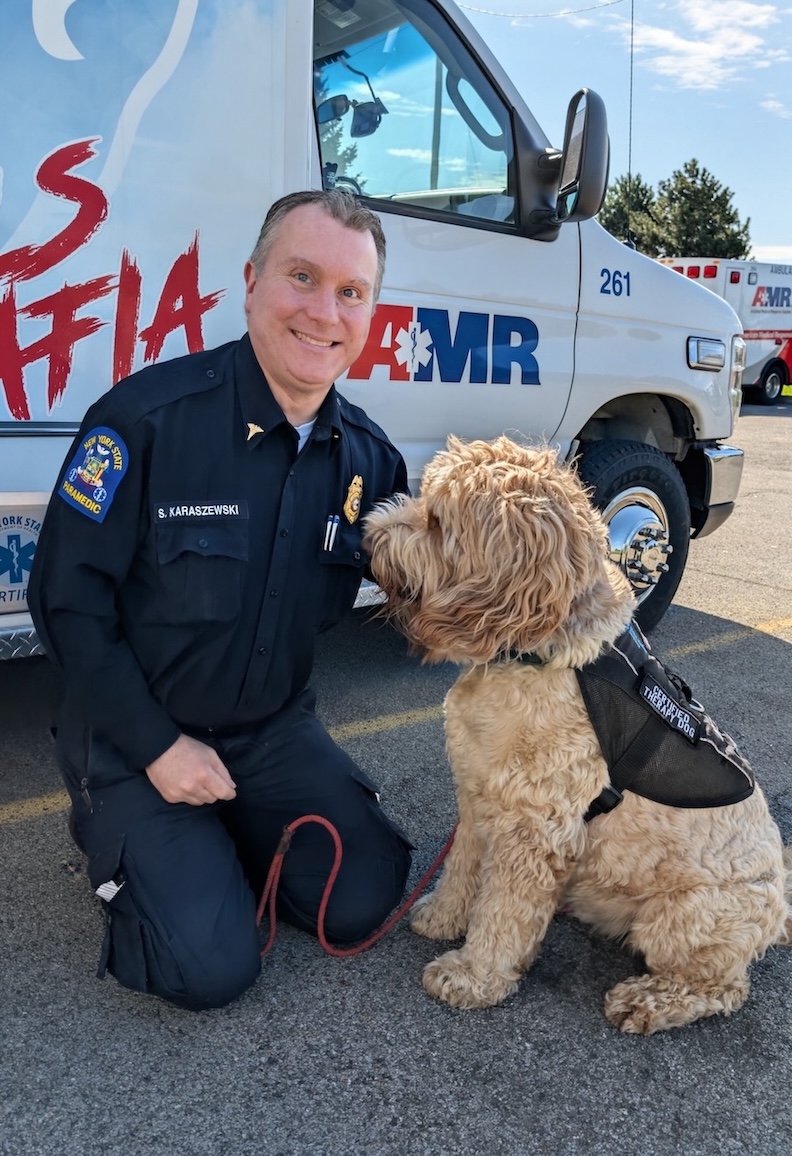
Rosco and Scott Karaszewski, chief EMS officer – and his handler and partner. (American Medical Response Inc. photos)
••••••••
Support without pressure
For many in EMS, support isn’t one-size-fits-all. Not everyone is ready to talk. Not everyone processes stress the same way. That’s where Rosco fits in.
Therapy dogs play an important role in supporting the emotional well-being of first responders, particularly in environments where exposure to trauma is routine. Research shows that interacting with therapy dogs can lower cortisol levels, a hormone associated with stress, and increase oxytocin, a hormone tied to bonding and emotional regulation. For first responders routinely exposed to medical trauma and high-pressure situations, even a few moments with a therapy dog can provide meaningful relief.
“When I started in EMS, talking about difficult calls wasn’t something that was encouraged,” Karaszewski said. “Even though times have changed and providers are encouraged to talk, it’s not always in their nature. This gives our team another option. It allows people to release stress without having to explain anything unless they want to.”
Therapy dogs like Rosco are part of a broader effort to provide multiple ways for EMS professionals to manage stress and maintain emotional well-being.
The moments that matter
Much of Rosco’s work happens in private, where trust matters most. But his handler recalls a personal moment that reflects the role he plays. After dropping his son off at college, Rosco, who typically prefers cooler spaces and sleeps on the floor, stayed close throughout the night.
“He’s not a dog that usually sleeps in the bed,” Karaszewski said. “But that night, he stayed right next to me the entire time. He knew.”
It was a small moment, but one that spoke clearly: Rosco shows up when he’s needed.
A national effort to support first responders
Rosco is one of 44 hypoallergenic doodle dogs trained through the national GMR therapy dog team, a program designed to strengthen emotional resilience across the organization. Each dog is paired with a GMR employee handler and trained in emotional support, animal behavior, and peer interaction.
Since launching in 2016, the program has grown from a regional effort into a national resource, supporting EMS professionals, hospital systems and communities during critical incidents and times of need. Therapy dogs like Rosco are intentionally integrated into daily operations to help reduce burnout and support the mental well-being of EMS personnel.
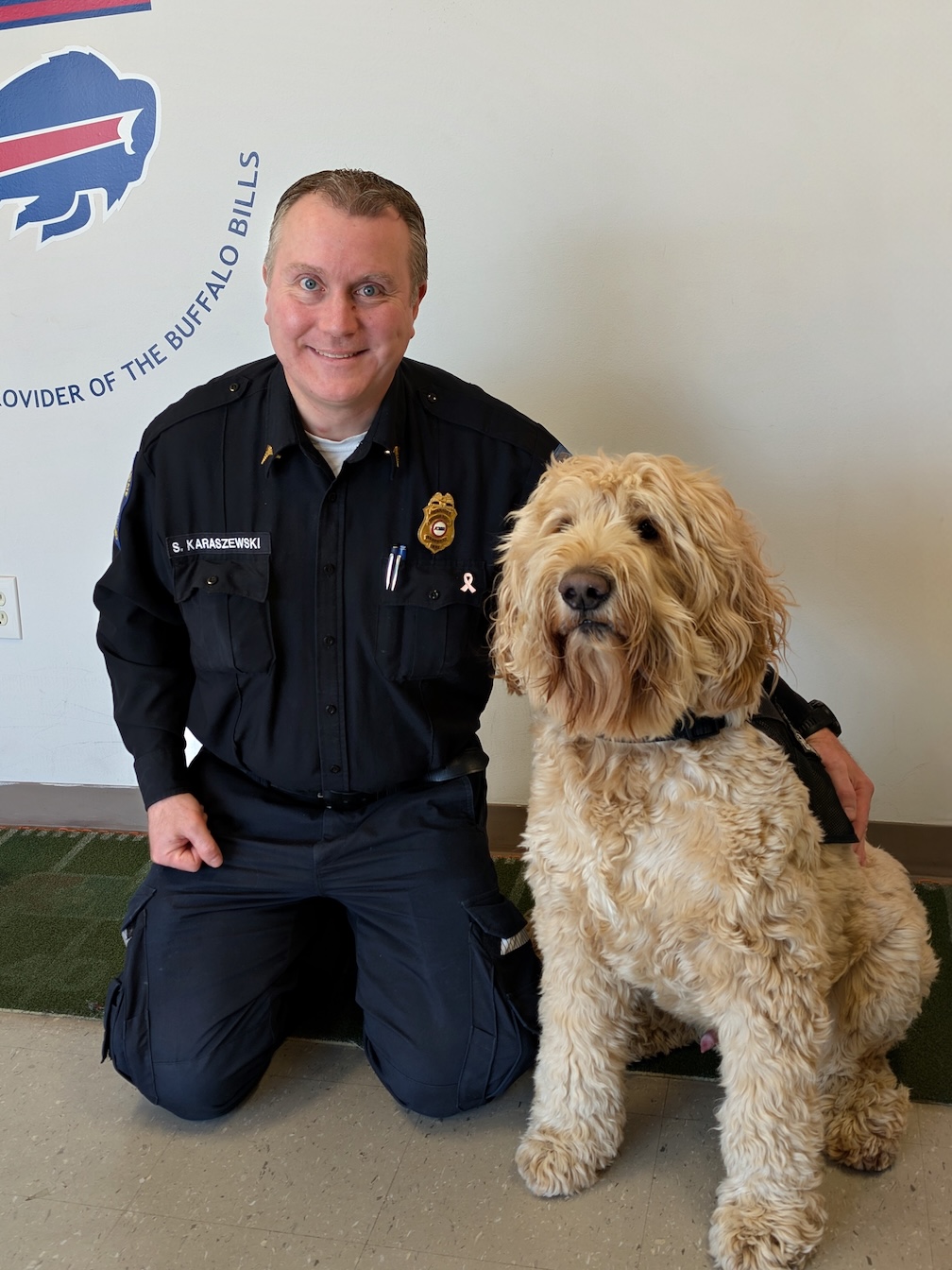
Rosco and Scott Karaszewski, chief EMS officer – and his handler and partner. (American Medical Response Inc. photos)
••••••••
A personality all his own
When he’s off duty, Rosco enjoys life like any other dog. He plays with his favorite stuffed Lamb Chop, chases balls and anything with a squeaker, and looks forward to treats like pumpkin rings, bully sticks and doggie meatballs.
On warmer days, he can usually be found stretched out in front of an air conditioning vent or relaxing on a cooling mat. And like any good member of the team, he takes his afternoon naps seriously.
Supporting the people behind the calls
In EMS, every provider is different. Each call is different. And the way people carry those experiences can look different, too.
“Having Rosco gives us another way to support our people,” Karaszewski said. “He meets them where they are, in whatever way they need that day.”
Because not every moment can be talked through. But that doesn’t mean it has to be carried alone.
More about GMR therapy dog program: Developed in 2016, the GMR therapy dog team includes 44 hypoallergenic “doodle” breeds that are selected based on physical and temperamental traits. Each dog is accompanied by their handler, a GMR employee who is passionate about the well-being of their fellow GMR team members. Both GMR therapy dogs and handlers undergo extensive training to ensure there is foundational trust between dog and handler, which allows these canine partners to navigate delicate and often emotional situations. All GMR therapy dog handlers have worked in the EMS field, bringing a high degree of cultural competency to the interactions they have with fellow first responders.
For more information on the GMR therapy dog team, visit GMR Life.
American Medical Response Inc. provides mobile health care in 40 states and the District of Columbia. More than 28,000 AMR paramedics, EMTs, RNs and other professionals work together to care for more than 4.8 million patients nationwide each year in critical, emergency and non-emergency situations. For more information about AMR, visit www.amr.net or on Facebook and LinkedIn.
AMR is part of Global Medical Response, the largest air and ground emergency medical service provider in the U.S. With 34,000 team members, the organization reaches more than 61% of the U.S. population, providing emergency medical care to 5.5 million patients annually and performing a critical intervention every 91 seconds. For over two decades, GMR’s office of emergency management has partnered with FEMA, DHS, HHS, state agencies, and private partners to deliver rapid, life-saving services during large-scale disasters, acts of terrorism, and public health emergencies, deploying over 80 times across all 10 FEMA regions. Its family of solutions includes ground ambulances, as well as multiple air EMS organizations including Air Evac Lifeteam, REACH Air Medical Services, Guardian Flight, Med-Trans Corp. and AirMed International. For additional information, visit GMR at www.globalmedicalresponse.com, or on Facebook and LinkedIn.




















1859 Whitehaven Road, Grand Island, NY 14072
Phone: 716-773-7676
Fax: 716-773-7190