

+70
°
F
+74°
+58°
Niagara Falls
Thursday, 16
See 7-Day Forecast
Featured News - Current News - Archived News - News Categories

By Christine Giarrizzo
We’re at a family party, and I’m deflecting offers of snacks and sweets for my kids like I’m Michonne fighting off zombies with a katana.
“No thank you, it’s almost bedtime,” I repeat, over and over.
I step away for two minutes to use the bathroom.
Two. Minutes.
I come back to find both of my kids elbow-deep in a plate of Cheetos and cupcakes. It’s 7 p.m. Bedtime should be … fun.
I’m immediately frustrated. How many times did I say no? Was I unclear? Did they not hear me? Or did they just not care?
Because now I’m the one dealing with the sugar crash. The overtired meltdown. The chaos waiting for me after they fall asleep in the car.
I set a boundary. So, why wasn’t it respected?
Unfortunately, this isn’t a one-off. I’ve found myself here more times than I can count. Mentally replaying the moment. Chastising myself for not being firm enough. Annoyed with the family member who disregarded my wishes.
I was so fired up. So, naturally I did what I usually do: I decided to turn this into helpful content for other mamas. I was fully ready to record a podcast episode on how to set better boundaries and get people to actually respect them.
But somewhere in the middle of my research, it hit me. The realization that completely flipped the script:
Boundaries aren’t for them.
They’re for me.
I had been going about this all wrong.
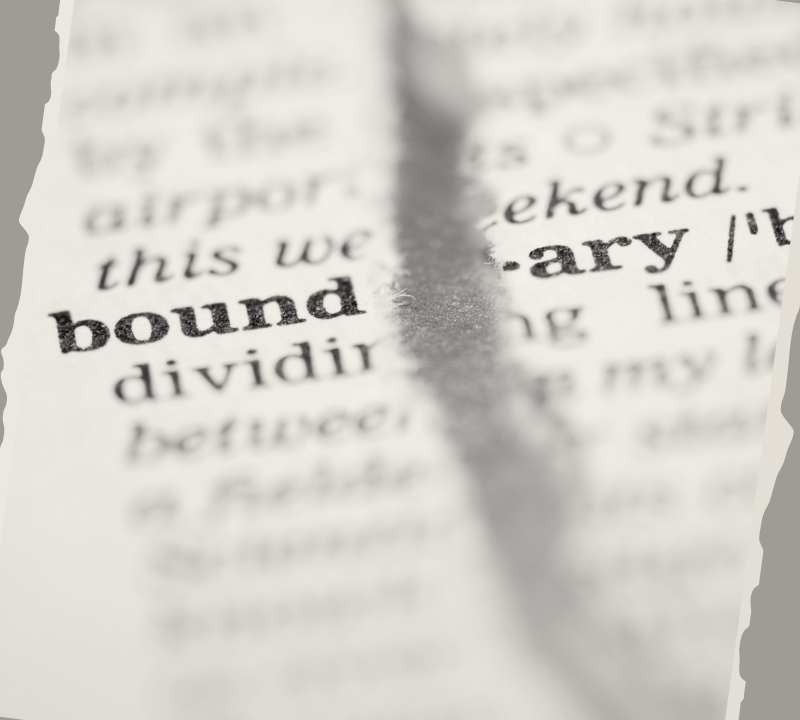
Boundaries are not about controlling other people’s behavior. Or setting edicts and expecting people to fall in line. They are about what you will and won’t tolerate. And what you’ll do about it.
By definition, boundaries are the standards by which you allow yourself to be treated – the limits you set for what’s acceptable, safe and respectful in your relationships. So no, it’s not just me being “particular.” It’s backed by psychology.
When we treat boundaries as rules for other people, we feel disrespected when they’re not followed. We get resentful and often spiral wondering why no one listens. When we understand that boundaries are for us, we can take back control and reduce the anxiety and resentment we feel. And stop playing referee of everyone else’s actions.
I thought a boundary meant: “Don’t give my kids sugar.”
But a boundary actually means: “If you give my kids sugar, here’s what I will do next.”
It’s a skill I’m learning and practicing as I go. I’ve started relying on boundaries more so my kiddos know what to expect from me and other caregivers, and to always make sure they’re safe.
How to actually set a boundary
•Get clear on your limits: Take a step back and evaluate your core values and beliefs. Think about your absolute deal breakers. Your nonnegotiables. Something you would never want your child exposed to.
For me, it’s things like being around smoking or vaping, physical discipline, or being given pop, candy or junk food.
•Say it clearly, without overexplaining: Communicate your limits directly and in the moment. Be clear and specific.
“Hey, no sugar tonight. We’re heading home soon and bedtime will be rough.”
•Decide your follow-through (THIS is the boundary): This is the part I was missing. I set the boundary clearly. But when it wasn’t followed, I just internalized my anger and resentment.
Now I get it. If someone ignores what I’ve said, the boundary is what I do next to protect myself and my kids. And sometimes that means making tough, unpopular decisions.
“If they have sweets, we’re leaving early.”
“If it keeps happening, we won’t be attending anymore parties.”
•Be firm and consistent: A boundary without follow-through isn’t a boundary. It’s a suggestion. I’ve learned that if I don’t enforce it, it doesn’t stick. Not because people are trying to be disrespectful, but because I’ve shown them it’s flexible.
Boundaries can be uncomfortable. Especially in families.
There’s something about telling the people who raised you – or who love your kids like their own – what you’re not OK with that makes you feel like you’re doing something wrong. Even when you’re not.
I’ve had to learn that prioritizing my kids’ well-being (and honestly, my own sanity) matters more than avoiding an awkward moment. And how I say it matters just as much as what I say.
What I’m doing differently now
•Keeping it collaborative, not confrontational: I’m not coming in hot. I’m just sharing what works for us.
“I know it’s fun to treat them, but bedtime gets really tough after. Can you check with me before giving them sweets?”
•Keeping it simple and clear: No justifications. Just the ask.
•Using “I” statements: (Yes, I know it’s cliché, but it works!) “I’m trying to keep evenings calmer during the week.” It keeps the focus on me and not what they’re doing wrong.
•Expecting pushback: The eye rolls. “It’s just one cupcake.” It happens.
But just because someone doesn’t like my boundary doesn’t mean it’s wrong.
•Not over-explaining: I used to think if I said it the right way, it would be respected.
But over-explaining doesn’t make a boundary stronger.
It makes it negotiable.
The truth is, no one at that party was responsible for my boundary.
Not the aunt with the cupcakes. Not the well-meaning grandparent.
I was.
And once I understood that, everything changed. Not because people suddenly behaved differently, but because I did.
Boundaries aren’t about controlling the room.
They’re about deciding how you show up in it.
••••••••
Christine Giarrizzo is a blogger, podcaster and mama of two, navigating the realities of modern motherhood in real time. Through her writing, she explores the tension between who we were, who we’re expected to be, and who we actually want to become.
Her work focuses on helping millennial moms move out of survival mode and into a life rooted in clarity, creativity and self-expression. Through honest storytelling and research-backed insights, Christine creates space for women to question outdated norms, trust themselves, and build lives that feel aligned and fulfilling – while offering practical tools for moms who feel overwhelmed and ready to reconnect with themselves.
You can find more from Christine at ContemplativeMama.com and on Instagram @ContemplativeMama1.





























1859 Whitehaven Road, Grand Island, NY 14072
Phone: 716-773-7676
Fax: 716-773-7190