

+70
°
F
+74°
+58°
Niagara Falls
Thursday, 16
See 7-Day Forecast
Featured News - Current News - Archived News - News Categories
Article and Photo by Alice Gerard
Senior Contributing Writer
Women faced a complicated process in the 19th century when they got dressed in the morning.
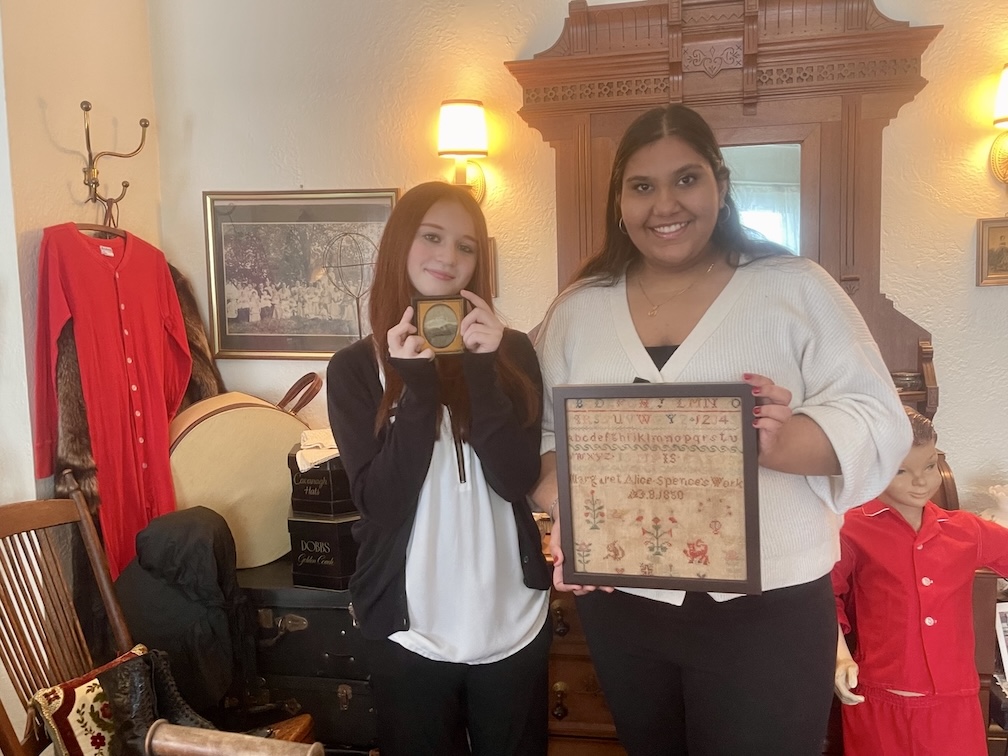
Grand Island High School sophomores Gabby Grisanti and Sukhmani Kaur, who served as docents in the second-floor bedroom at the recent Christmas open house at River Lea, were there to describe the process – as well as to talk about the rest of the displays in that room.
“I think that the whole dressing thing is really interesting to me because of how many layers they had to wear,” Gabby said. “I also think how many hatboxes are in here is crazy to me. There are so many. Nowadays, you don’t see people wearing big, fancy hats. You don’t really see much of that now.
“For the women to get dressed, they would start off by putting their stockings on. Then they would put on their boots, which were interchangeable. They would alternate them: left boot, right boot. That way, (the boots) would wear evenly. Then they would put their bloomers on, which were their undergarments. …
“They would put their cages on, which would hold the skirts up. The front of it would have nothing there so it wouldn’t fly up into their faces. In the back, there would be a bump out so they could put a cushion over their backside so that it would look a little bit bigger. They would also wear corsets, and they would be very tight to make their waist look thinner. Sometimes, they’d even break ribs. After all of that, they’d put their blouses on. They’d put their skirts on. And that would be their typical get up.”
Sukhmani said she was fascinated by a small bed and two embroidery samplers in the room.
“I like this little bed,” she said. “It’s a cool piece of history that was preserved. I like how it was a way to treat their sick, their guests. It was a really cool innovation for the time, as well. It could fit through any door frame.”
Sukhmani also pointed out the age of the samplers, “And, of course, these being from 1850, 1823. It’s absolutely mind-blowing.”
Both Gabby and Sukhmani talked about how they chose to volunteer as docents with the Grand Island Historical Society.
“I saw a date for the Victorian morning thing. It was in my email,” Sukhmani said. “I didn’t want to come alone. I wasn’t really sure how the atmosphere would be, so I told my friend about it.”
“I got involved in this because I came here with my friend for a Victorian morning event to learn about this history,” Gabby said. “Then, Miss Maggie (Gushue) asked us if we were interested in volunteering. Now, we’re here.
“I like it a lot because you get to be involved in your community. You get to learn the history. I think it’s fascinating that this whole building was owned by (the cousin of a) president at one point. If you’re volunteering, you get to learn in depth about one room in specific, rather than a vague overview of all of them.”
The first owner of River Lea of River Lea was W. Cleveland Allen, the son of Lewis F. Allen, for whom Allentown is Buffalo is named. He owned Allenton Farms on Grand Island, and his nephew, who became President Grover Cleveland, worked for him, maintaining the farm records.
Sukhmani said she enjoyed her experience as a docent at River Lea: “I’m a huge history nerd. I love it here. If I could live here my entire life, I would.”
Gabby said she was happy “just getting to be here. Getting to serve my community. Getting to learn the history.”














1859 Whitehaven Road, Grand Island, NY 14072
Phone: 716-773-7676
Fax: 716-773-7190