

+70
°
F
+74°
+58°
Niagara Falls
Thursday, 16
See 7-Day Forecast
Featured News - Current News - Archived News - News Categories
Staff reports
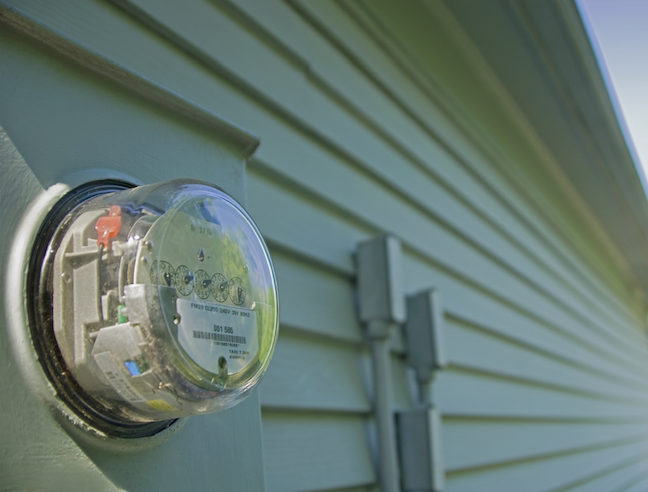
Western New Yorkers received a welcome education on smart meters Monday evening. A session at Porter Town Hall facilitated by First District Niagara County Legislator Irene Myers featured two representatives from utility provider National Grid, who clarified the questions of many when it comes to the new electrical monitoring devices now being installed in many residences.
“I hope that this will answer all of your questions and your uncertainties of what you would like and expect from smart meters,” Myers said.
With that, Ken Kujawa, regional director of the London-based National Grid, presented an overview of the high-tech smart meters to a packed meeting room of curious residents. He was accompanied by Patrick Uhteg, manager of National Grid Erie and Niagara.
“Patrick and I are going to attain the frustration tonight to talk about smart meters. We know it’s been a topic in Western New York going back to the summer of 2024 when smart meters were being installed by New York State Electric and Gas in their service territory up here in Western New York,” Kujawa said.
He and Uhteg then went on to discuss concerns surrounding smart meters, which they attributed to “media attention” on how the NYSE&G installations were received by the community.
“National Grid comes after New York State Electric and Gas with our smart meter installations. And we know that people have been getting communication from National Grid on our program,” Kujawa said.
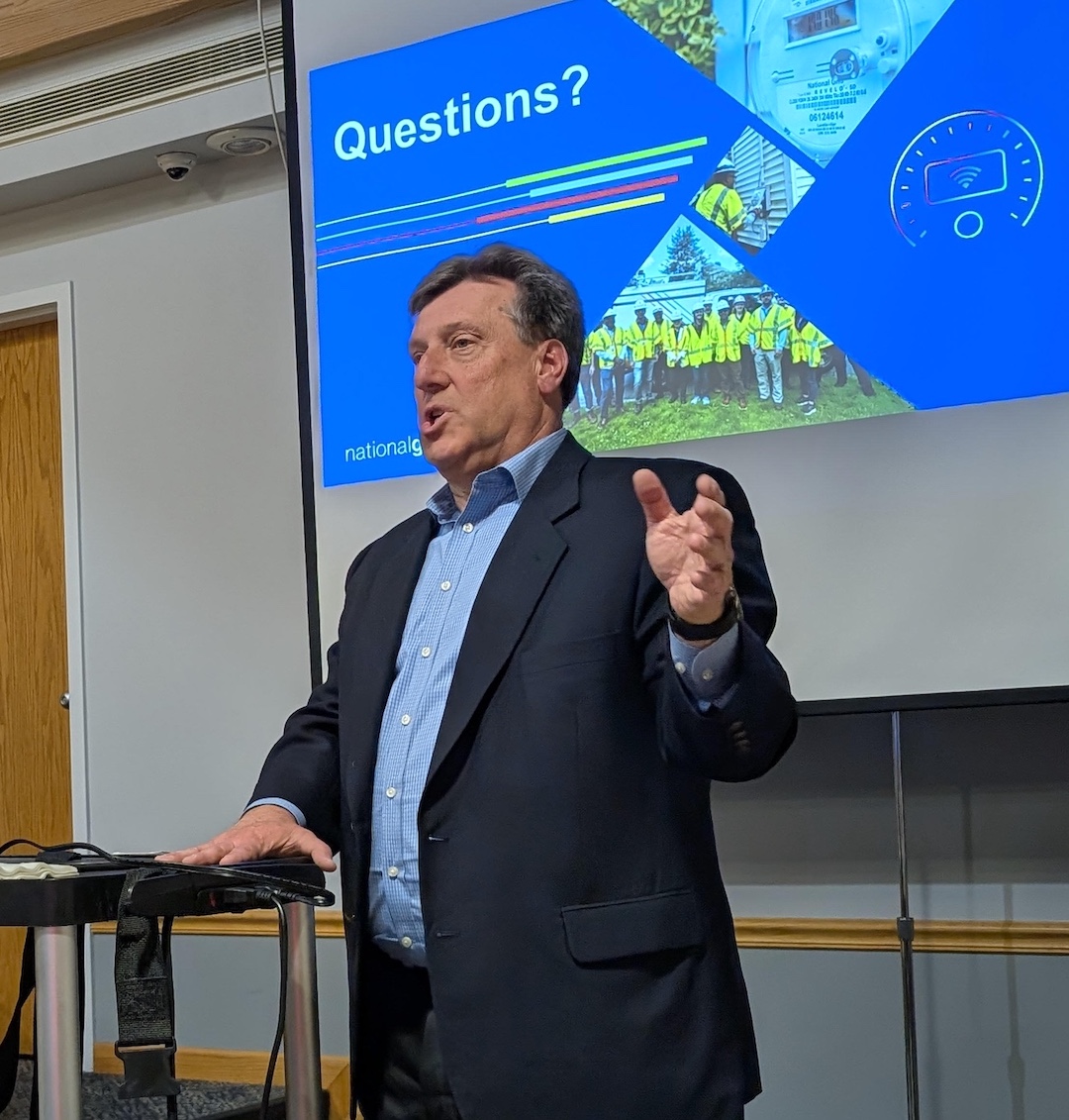
National Grid regional director Ken Kujawa discussed new smart meters with a Porter audience.
••••••••
Kujawa moved to a hot topic for many: high electrical bills: “You probably saw (a) fairly significant increase in your electric bills and the time of that increase. … Why did we see the electric bills go up in January and February?”
He attributed this to various causes, including a harsh winter, the strain on home heating systems and, in turn, the spikes in energy consumption on the supply side. But the most impactful was from increases in the cost of natural gas.
“Energy consumption ticked up right around the same time that natural gas and electric supply prices were at their highest point,” Kujawa said. “A lot of folks don’t realize that, in New York state when we generate electricity … that comes from power plants that are burning natural gas to spin the turbine that is ultimately used to produce the electricity. … If natural gas prices go up, electricity prices in New York state follow the same path.”
Added to this supply-side cost is the delivery fees National Grid places on consumers in order to maintain its infrastructure. Together, all three issues impacted consumers this past winter and the ability to handle rising costs, Kujawa said. Adding to these consumer worries and confusion was National Grid’s launch of smart meter installations in Buffalo-Niagara over past months.
“I’m just going to give you some facts about smart meters, why we’re doing this, why we’re replacing them,” Uhteg said.
He noted the current meters found in many residences are known as manual-read devices; the units are roughly 20 years old and now in need of updates.
“We went from manual-read meters to what is called an AMR meter (currently in residences) that had to be read by a visiting National Grid staffer in a vehicle,” Uhteg said.
The new smart meters are intended to eliminate the expense of onsite reading.
Uhteg said National Grid is now in the process of installing 1.75 million smart readers throughout upstate New York, and that 89% of the meters installed in the U.S. are already using smart meter technology. He went on to note the accuracy of the devices.
“I think our rate of accuracy is 99.94(%),” Uhteg said. “We’re working on 0.06(%), but it’s a high level of accuracy. We do test every smart meter (before installation), and they are reading at that same if not better level of accuracy.
“There’s no change in (consumer) usage, it’s just a new meter reading the same usage, reading the same kWh that your house used.”
Uhteg said there are benefits for consumers who switch over. Included is the smart meter’s enhanced outage detection capability in a storm response. With smart meters, “we’re transitioning from what is called a predictive metering system and outage management system to an actual” (notification) to National Grid.
“Now we’re able to transition to actual and immediate response notification” from a power outage. “Rather than wait for everyone to start calling in (outage reports), we know about (these). And we know exactly which premises are out of power and that gives us an actual” location of a problem.
Uhteg said smart meter technology “really makes it a lot more efficient for us (to respond). And more convenient for you. … (It) enables faster storm response because we’re no longer out patrolling and looking for the trouble (during outages). We’re out driving to where our system told us the trouble is, because of that detection using the smart meter.”
He continued to discuss the benefits of the new devices, including greater consumer control of electrical devices and energy use. Among these, he said consumers can track the actual kilowatt usage of electrical devices within the home via these meters and, in turn, better monitor their energy use and cost. He said one option, called time of use rate, is a standard offering by National Grid that allows consumers to better plan their energy uses.
“But we don’t change your rate (charged) when we change your meter,” Uhteg said. “You’re on the regular SC1 service class 1 residential use, which is not time of use.”
He said the new smart meters being installed are expected to have a usage life of 20 to 25 years.
Opting out
Uhteg explained the process of opting out for those who do not wish to install a smart meter. National Grid is availing this process for consumers. Further information is available by visiting www.ngrid.com/optout or calling 1-800-642-4272.
“What happens is that we do take out the AMR meter because they are in end of life,” Uhteg said. “We put in a new manual read meter. It does have to be manually read each month, and because we still have to come out to that location and manually read the meter, there’s an optout fee of $15.45 per month.”
Uhteg said National Grid’s $72.44 one-time optout fee only applies to those who had a smart meter installed and now want to revert back to the manual read models.
The National Grid reps went on to explain the utility provider’s earlier rate increase requests, which were all approved by the state Public Service Commission.
“We did have a three-year rate filing that was approved,” Kujawa said. “Our delivery charges did go up as of Sept. 1, and then on April 1 our bills are going to go up. We’re estimating right now for a customer that uses around 625 kilowatt hours per month, that’s a little over $6 per month that you’re going to see.”
The balance of the Porter information session included an assortment of Q&A topics from visitors, including opting out and the costs; the impact of solar installations at residences and billing; consumer data/privacy concerns; smart meter applicability in older residences and any risk of fire; and smart meter reliability/expectations.
For more information, visit www.ngrid.com/smartmeter.



























1859 Whitehaven Road, Grand Island, NY 14072
Phone: 716-773-7676
Fax: 716-773-7190