


+70
°
F
+74°
+58°
Niagara Falls
Thursday, 16
See 7-Day Forecast
Featured News - Current News - Archived News - News Categories
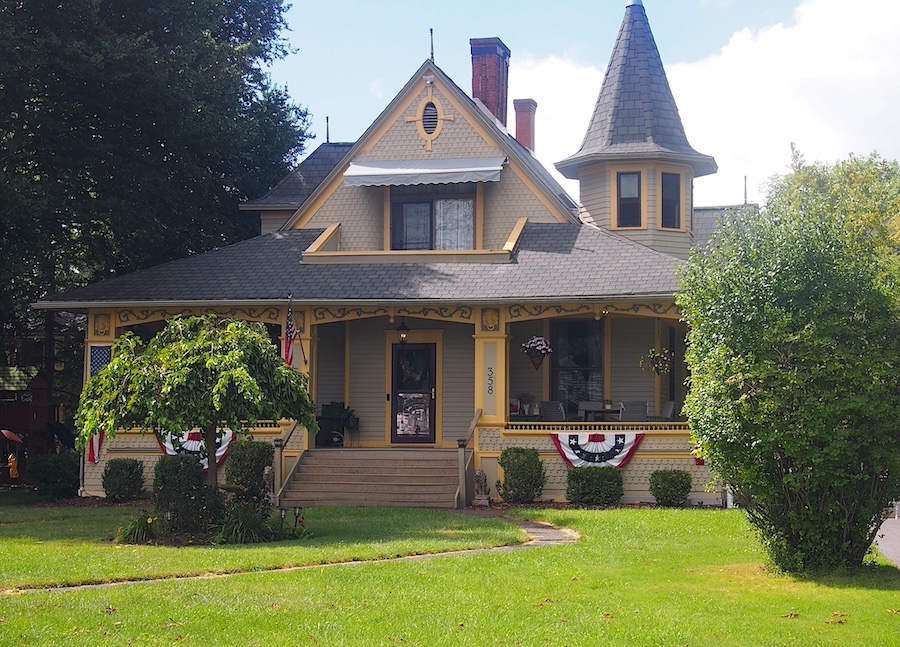
Story and Photo by Alice Gerard
Senior Contributing Writer
Fashion through history was the theme on Sept. 8 at River Lea, the Grand Island Historical Society’s museum located in Beaver Island State Park. One day earlier, the architecture of Ferry Village was the focus for a walking tour. The weather was less than ideal for the walking tour, as it intermittently rained.
The fashions were on display as part of the all-Grand Island history weekend from Sept. 6-8, organized by the Grand Island Preservation Advisory Board. Other events included the Ferry Village walking tour, led by Sharon Nichols and Denise Dewey. Nichols is a member of the Preservation Advisory Board and Dewey is recording secretary for the Grand Island Historical Society. In addition, the history room at the Buffalo Launch Club was opened for visitors, held in conjunction with the Antique and Classic Boat Show, held Sept. 7, and the Alt farm was open for tours Sept. 8.
The tour of Ferry Village began at the hot dog stand on Ferry Road (now known as Casey’s Cabana), near the location that was formerly the home for the Bedell House, which was built in 1877. The three-story structure served as a hotel for people visiting the Island until 1935. Highlights of the tour included the landing site on Bedell Road of one of the ferries that transported people and vehicles between Grand Island and the mainland.
According to written information provided at the guided tour, the ferries began operation at about 1825 and they ended operations in 1935, when bridges between the Island and the mainland were completed. Brothers Frank and Charlie Fix, who lived on Ferry Street, were captains of many ferry boats. In addition to that work, they were well-known as rum runners during prohibition.
The rum running of the Fix brothers was highlighted during a presentation at the Buffalo Launch Club on Feb. 4 and 25, 2023. Mary Cooke, corresponding secretary for the Grand Island Advisory Board, was quoted in a Dispatch article as saying: “Grand Island didn’t have a lot of population, but it did have roads. One of the articles I read talked about how the roads were pretty deserted early in the morning, which allowed the Fix brothers and other rum runners to go to Canada, where they could produce alcohol and bring it to the Island. There were many places along the shoreline where it could be stowed. Then trucks could come and pick it up at these very secret places along these well-built roads that no one was on.
“The Bedell House was one of the places where you could allegedly get a drink. Whatever you wanted. So, people (agents) would come under cover. Ironically, the Fix brothers owned the ferries, so they were bringing the agents to do the raids. One time, the agents were screaming at the Fix brothers. Stupidly, the feds shouted at them before they (the brothers) docked the boats, ‘We have warrants for your arrest!’ The Fix brothers turned the boat around and went the other way.”
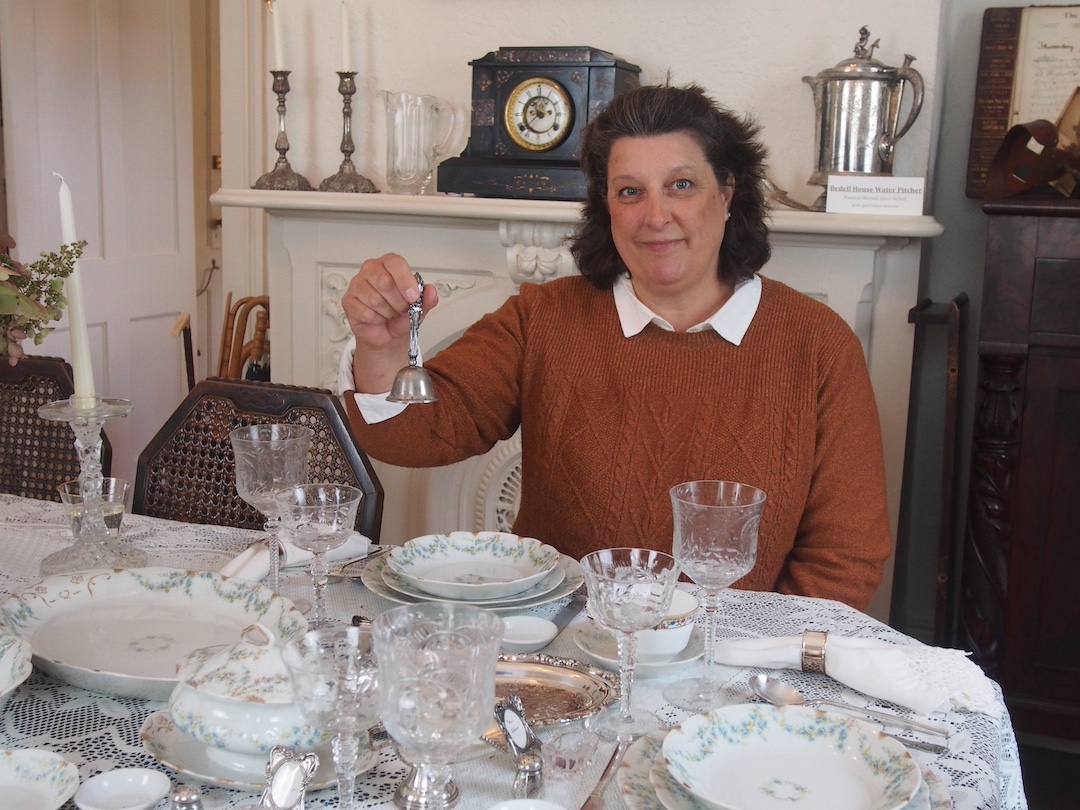
Ann Nichols Ruland taste tests tea at a table set for a Bedell House tea party.
••••••••
At River Lea, there were mannequins in many of the rooms, dressed in a variety of outfits from different periods of history. At least one of the dresses on display was an outfit that a woman might have worn during a social event at the Bedell House.
“We have a 1900s tea dress, so we decided she might have gone to the Bedell House and had tea at the hotel,” explained Ann Nichols Ruland, who offered tours to visitors at River Lea. That dress was on display in the kitchen, along with a depiction of a “1900s house worker and … some of the tools and instruments and her household chores.”
The tea at the hotel was depicted with a tea setting in the dining room, which was created to portray a high tea at the Bedell House by Historical Society members Maggie Gushue and Carolyn Doebert, Ruland explained.
“We talked a little about fancy dances coming to the Island,” Ruland said. “You go to some of the clubhouses for the parties. The Harvest Moon dance. Upstairs, we have an Edwardian dress, and we pictured her sort of a Charlotte Sidway woman who lived in Buffalo and had a very nice estate, fully staffed, on the Island, and that she would be here with her husband, who was probably at one of the many clubhouses, fishing, hunting, boating. So, that covered a lot of what happened on the Island at a certain time period. But then, Denise Dewey brought a dress that was Mary Mesmer’s, who married Mike Fleischman. Then, we thought, that’s a good topic, to talk about the dairymen of Grand Island. They were very prominent and they were very successful at the time period of … it must have been the late-1800s to early- to mid-1920s or 1930s and on.”
The display of mannequins was meant to “be of interest to all Island,” Ruhland said. “Our initial inspiration was to dress the mannequins in different periods and then and then to discuss the periods of each mannequin’s clothing. One of the dresses on display belonged to Alice Doebert.”
She was the mother-in-law of Preservation Advisory Board member Carolyn Doebert. Alice Doebert also was interested in local history. Her penny square quilt of events at the 1901 Pan American Exposition in Buffalo was on display at a quilt show at River Lea in 1989, according to an article written by Ruth Stahl in the Island Dispatch dated Oct. 20, 1989.
“In the living room, we have a 1970s party gown,” Ruland said. The owner of the gown, Jackie Stickyl, however, never had the chance to wear her fashion statement. As a result of the “Blizzard of 1977,” the party was canceled. “We discussed a little bit about the impact of the blizzard on the Island.” There were travel bans and the bridges were closed during the late-January storm that brought snow and high winds to Western New York.
“Up in the library, of course, our one-room schoolhouse is evolving into the centralized Sidway school, evolving into the Kaegebein-Huth-Middle School-High School school district,” Ruland said. “All played a big role on Grand Island, from the kids being ferried off Island in a boat or bused off Island by boat or bridge eventually. And then, becoming a centralized school district.”
Attendance at the open house, however, was light because it was held at the same time as the Buffalo Bills’ game against the Arizona Cardinals.
“It’s hard to go up against the Bills,” Ruland said. “But we really wanted to participate in the all-Island history weekend and be a part of it. Some of these displays and some of these outfits will be up until Christmas. People can come and see. We’re always open. We can pull anything out to discuss with anyone.”
“I think it’s good for the Historical Society to do these sort of displays,” Ruhland said. “We hope it draws people in. It’s good for us, and it helps us research when we do displays like this.”






















1859 Whitehaven Road, Grand Island, NY 14072
Phone: 716-773-7676
Fax: 716-773-7190