


+70
°
F
+74°
+58°
Niagara Falls
Thursday, 16
See 7-Day Forecast
Featured News - Current News - Archived News - News Categories
By Joshua Maloni
GM/Managing Editor
The cherry on top of weeks of snow accumulations and freezing-cold temperatures is ice dams forming in and above gutters across Western New York. Though not a new phenomenon, these blocks of ice – and the size and quantity of attached icicles – have not been this noticeable (or noisome) in recent years.
“Just the combination of the weather, the nonstop cold, the amount of snow we've gotten. There just hasn't been a break in the weather for it to melt. Usually, we don't see this extended period of cold like we've seen them. It's been many years,” said Warren’s Village Hardware operator Ashley Wesser.
“This Old House” describes ice dams as the product of snow melting, the water refreezing, and channeling down above and into gutters. This can lead to gutter damage, including collapse, as well as the potential for roof shingles to be damaged.
Warren’s Village Hardware has a remedy to attack these ice dams.
“We found that magnesium chloride is one of the preferred ice melters to use on the roof, and the best way to do it is to put it in a stocking,” Wesser said. “You fill a little stocking, tie a knot on the end, place it on your roof above the gutter and over the downspout, and that'll help melt everything and get it flowing – because the water can back up under your shingles. And then when that starts to melt, it'll come into your house. So, you want to get it flowing right at the gutter, so it can make its way down the downspout and not into your house.”
She said, “The best way is to use a roof rake. Unfortunately, our warehouse is out of them. But get the snow off and get right to the ice, and then just put the sock right on the ice. Let it work its way down.”
Wesser said, “People can fill stockings – and I can show them how to do that. I just used a water bottle and cut the bottom off and kind of used it as a funnel to fill a stocking.”
She explained, “Especially on a nice, sunny day, as the snow melts and the ice will melt a little bit, the magnesium chloride works down to negative 20, so it'll just kind of sink through and eat through that ice.”
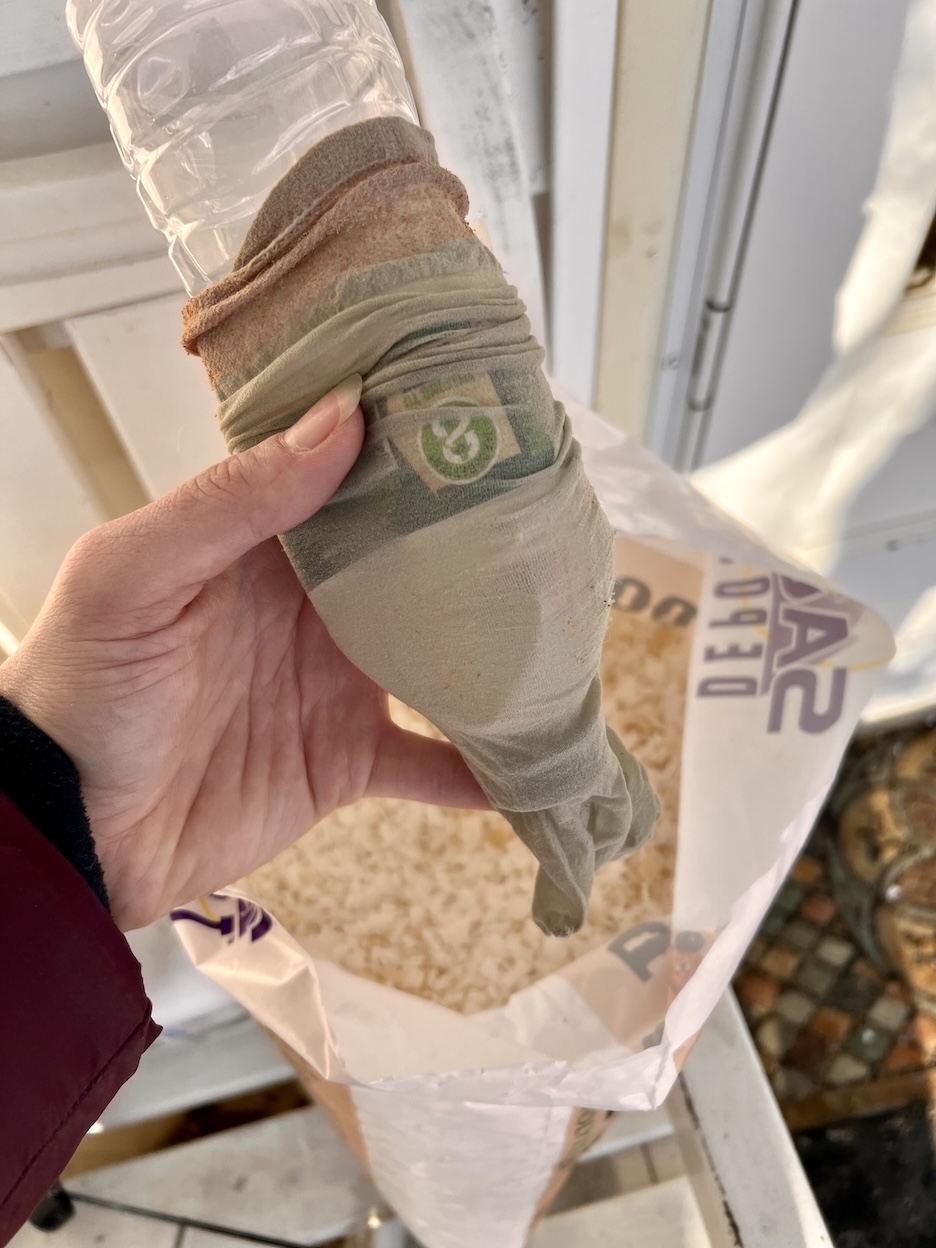
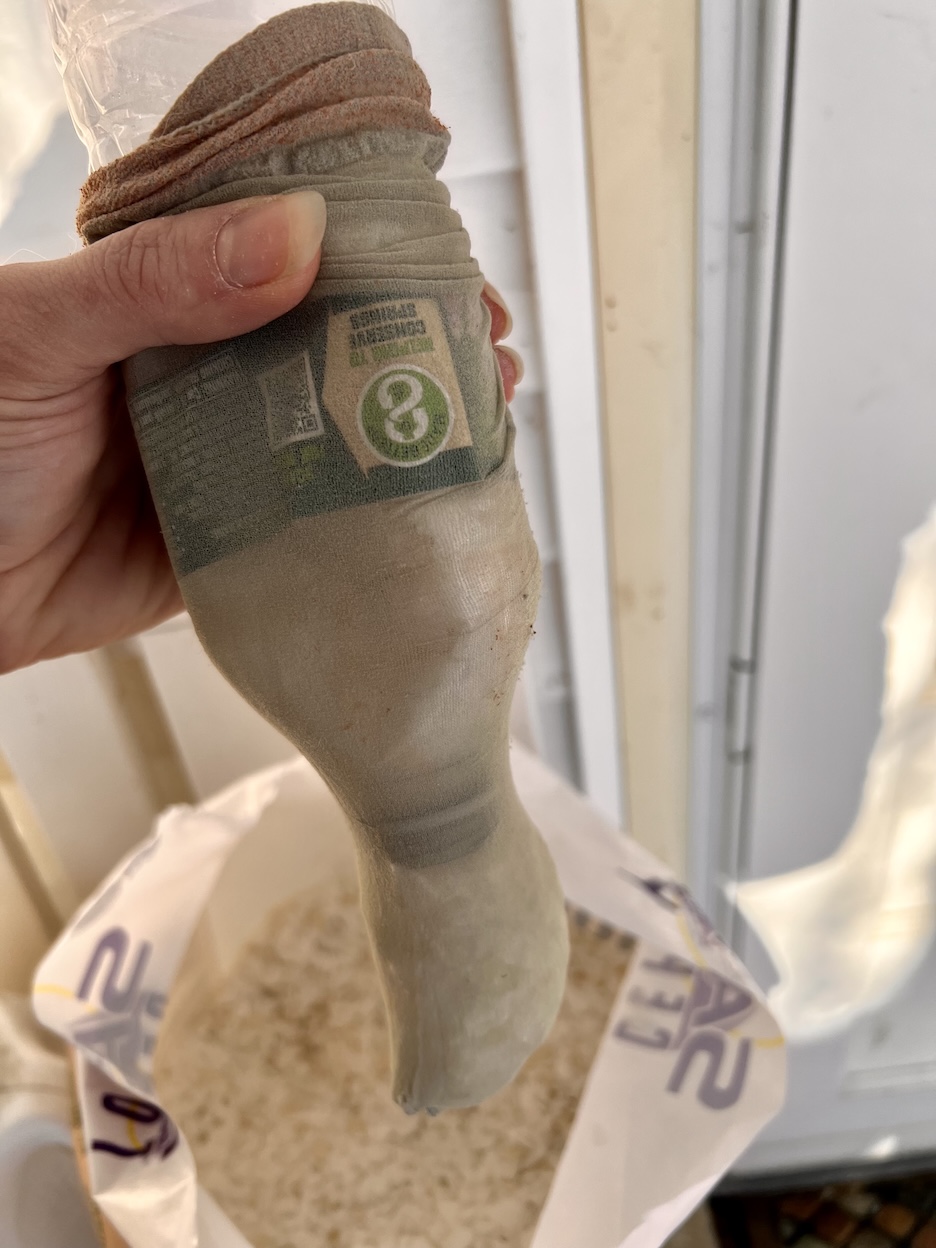
Warren’s Village Hardware suggests filling a stocking with magnesium chloride and placing the container at the gutter areas where ice dams have formed. (Photos courtesy of Ashley Wesser)

••••••••
Collecting the melting agent into a stocking is preferable to just throwing salt on the iced-over areas, as the stocking will “prolong the effect of it. If you just throw it up there, like the granular flakes, they only last so long until they dissipate. So, this gives you a quantity of it in one spot, and that lasts a lot longer,” Wesser said.
Magnesium chloride leeches through the stocking and into the ice.
The container serves to “keep it kind of isolated in one spot, so you have a quantity of it that'll melt through and last a lot longer, and melt through more ice, than just throwing up a little bit,” Wesser said.
How many stockings one should use “depends on how bad it is,” Wesser said. “We just did the corner of our house, the downspout, and kind of around the corner to give it somewhere to start flowing.”
She added, “One gentleman this morning had just a skylight that was near the edge of his roof, and that's the only place it was freezing. It wasn't properly either insulated or ventilated when they did the new skylight. So, it's only freezing in one little spot for him.
“Some people have their whole roof line, and then you want to line pretty much the whole thing, just to get it to melt down.”
Placing the stockings is better than chucking them.
“You can throw them up there, but it's best to get it right above the gutter, right where it needs to work right, so it can melt into the gutter and get everything flowing again,” Wesser said.
She spoke of the root cause of this winter weather challenge.
“Most times, ice dams and ice buildup, icicles, things like that, is a loss of heat, or not properly insulated attics, and not properly ventilated,” Wesser said. “So, you actually want to insulate kind of the floor of your attic, and let the heat escape out of the roof, and let it just be the same temperature as outside, and that way you don't get the buildup. But you also need ventilation in your soffits so that air circulates. That helps in the winter with the cold air, so it stays kind of one temperature. You don't have the heat coming out of your house, the snow falling on it, partially melting, freezing when it gets to the gutter, and then just building up from there.”
A related concern with large accumulations of snow and ice is what happens when the temperature does eventually and consistently rise – and the potential for flooding.
“It depends on how it (melts),” Wesser said. “Like, in Alaska, they call it a chinook. So, if it melts all of a sudden, rapidly, then you can have potential flooding. If it warms up gradually into the spring, then it shouldn't be as bad. If the ground is still frozen, and we get really warm and everything starts to melt, and there's nowhere for the water to go, then there's a problem. But if the ground kind of thaws and the water has somewhere to flow to, then everything's OK.”
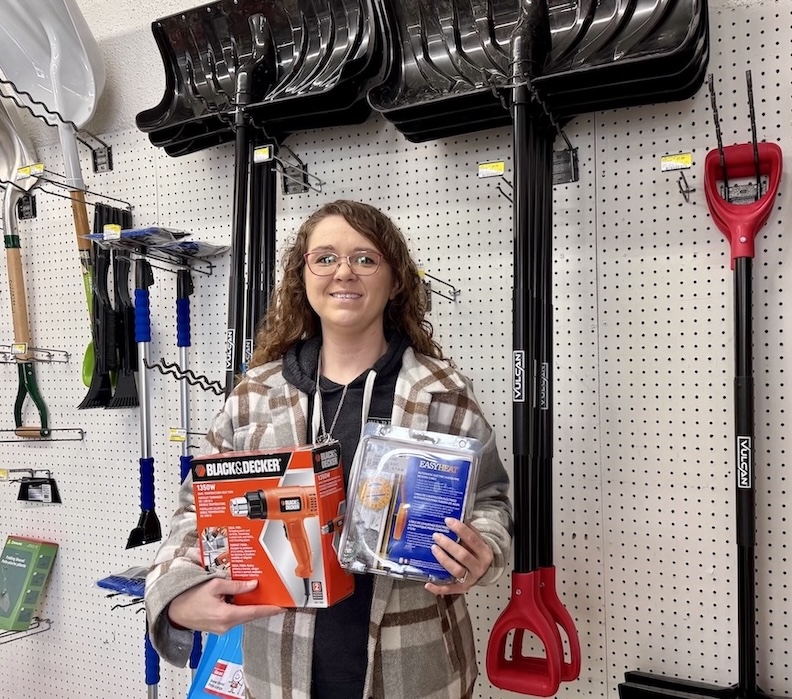
Warren's Village Hardware, located at 185 Portage Road, Lewiston, sells shovels, salt and other winter weather tools.
“If you have pipes that are close to like an exterior wall that get cold and you don't have a shutoff, say, for your outdoor faucet, you can put heat tape on that; which we do stock,” Wesser said. “We have heat guns. If you get a frozen pipe, the heat guns or like a soldering torch are good. Heat guns are a little better – you don't have an exposed flame.
“We have heaters in stock. If your heat goes out, and you just need something to plug in to keep everything warm, we have heaters in stock.”































1859 Whitehaven Road, Grand Island, NY 14072
Phone: 716-773-7676
Fax: 716-773-7190