


+70
°
F
+74°
+58°
Niagara Falls
Thursday, 16
See 7-Day Forecast
Featured News - Current News - Archived News - News Categories
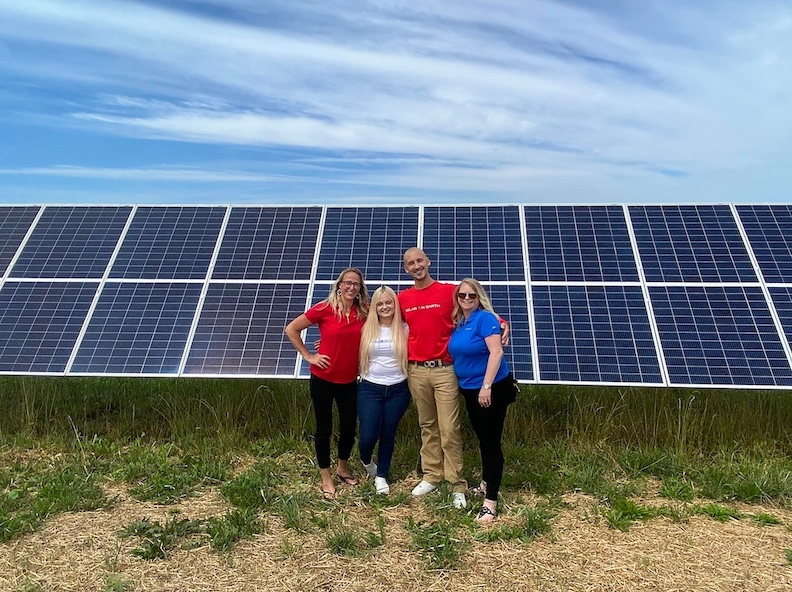
By Benjamin Joe
Wheatfield may be getting a little greener, as its Town Board mulls over whether to accept a discount on electric bills by supporting solar electricity.
Tysheen Roundtree, a representative of Solar On Earth, approached the Town of Wheatfield Board on Monday, April 7, at its regular business meeting. He presented a pitch for the town and its residents to Supervisor Don MacSwan and councilmen, as well as several residents in the crowd.
The deal was simple: Sign up with Solar On Earth and take 10% off costs for electricity.
“The reason is, No. 1, right now, New York state is pushing clean energy. They want to promote the program. They want to promote clean energy. …This is the program they invented to do that,” Roundtree said.
The board seemed skeptical of the offer, though Roundtree stated the town could save up to $9,300 each year. MacSwan asked Roundtree to call his office and make an appointment, so he and councilmen could hear more about the deal before making a commitment.
“I can’t really say much, because I don’t really know much about it,” MacSwan later said. “His 10-minute talk that he gave really didn’t tell me much of anything. I mean, is there any glitches? Are we committing to something?
“What happens if we lose power from that solar? Do we have to pay more to go back? There’s all sorts of things. I’m wondering about any possible penalties. It all sounds great, and when someone is selling you something it always sounds great. But then we need to find out what the downside is.”
Following the pitch, Gordon Smith, marketing manager for Solar On Earth, described the energy choices as a shopping mall. Smith said there are “anchor subscribers,” or big stores with large electricity needs. Then there are other subscribers, including residents and small businesses, which are like smaller shops, and will not be using as much electricity.
At this moment, he said, there is a push for municipalities to come aboard to be those anchor subscribers and start utilizing the solar arrays, also known as solar farms, in its utility’s footprint.
Smith described the situation as being a win for everyone involved.
“They (the towns) are looking for ways to trim their expenses, and many of the states are looking to be ‘green’ by a certain date,” he said.
Solar On Earth has worked on such projects across the nation and is based in Acton, Massachusetts.
Smith also said that, by going to the municipality first, the proposal is given weight to residents of the town. More people will listen to the proposal, and possibly sign up.
“If we get the commitment from the municipality, they’ll often put a letter in with the local bills and information they’re mailing out that they’re working with this company, and if you want to save 10% off your electrical bill, you can call them, go to their website, and if they call you, they have our blessing,” Smith said.
The goal of the company, which is funded by the solar array developers, is to allocate energy from the solar array to customers.
Smith noted solar energy is cheaper to produce than energy from natural gas because, following the installation of the solar array, very little has to be done to keep the creation of energy going. If customers want to pick up on these savings, signing up with Solar On Earth is the best way to do it, and it sends a message to the utility to produce more solar electricity, he said.
“The catch is there isn’t a catch,” Smith said. “The solar farms want to be able to develop more solar farms, obviously. They want to be able to go from place to place and do more. What this enables people to do is adopt solar energy and renewable energy.”
Smith made the distinction, though, about what solar developers are being helped with this program. In response to whether large-scale utility grade solar arrays, such as the Bear Ridge Solar Project in Cambria and the proposed Ridge View Solar Project in Hartland, are being supported when signing with Solar On Earth, Smith said, “I can’t unequivocally know that that’s not what happens, but I also can’t say that is what happens. Generally, the solar farms we work with are not big, massive utility-grade solar farms. Ours are limited to 5 megawatts.”
“I have talked to folks on both sides of that conflict,” he continued. “They don’t like the look of solar panels on farmland. I’ve also talked to farmers who sit there and say, ‘Y’know our ability to make a profit off our land is getting smaller and smaller every year, so I wanted to put out some of our land that wasn’t really productive for us, and I wanted to put a solar array there, but my neighbors wouldn’t let me.’
“I’m sitting there going, ‘OK, this is your land, and your neighbors are telling you their view is more important than your ability to keep your land as farmland or clear of more houses?’
“I grew up on a farm, and I go back to that neighborhood and I see where the dairy farm right next to me that had several hundred head of cattle and much larger acreage than the little farm I grew up on. Now most of their land is covered with houses. They had no choice except to sell off, piece by piece, and now where there was corn fields, there’s housefields.”
Councilman Larry Helwig echoed MacSwan’s concerns, noting that, in Texas, many residents and businesses were sold on solar, but after an ice storm, they lost power.
“He gave us all the good points,” Helwig said. “Save 10%. He didn’t tell us the cost. He said it was free, but I’m a little skeptical. … Texas had a big ice storm and their solar grids froze up and didn’t provide electricity. They had to rebuy the electricity from the private grid and the costs skyrocketed. I just want to know what happens in Buffalo and Western New York when we get a snowstorm?”
In response, Smith said the kilowatt hours credits accumulated in the summer months when energy generation was high would guarantee that the discount does not go away, even if the electrical source is not solar during a winter storm.
“That’s what the state has regulated; so, whatever happens, you will always pay less,” he said.
At this time, Roundtree has not met with the board. MacSwan said the meeting is scheduled the week following this publication.
























1859 Whitehaven Road, Grand Island, NY 14072
Phone: 716-773-7676
Fax: 716-773-7190