

+70
°
F
+74°
+58°
Niagara Falls
Thursday, 16
See 7-Day Forecast
Featured News - Current News - Archived News - News Categories

By Karen Carr Keefe
Senior Contributing Writer
A move to pause the 2025 reassessment was rejected 4-1 by the Grand Island Town Board during a sometimes-contentious Monday workshop meeting.
Council member Dan Kilmer was the only one to vote in favor of his own motion to halt the assessment project that has drawn criticism and prompted requests for informal reviews from more than 600 homeowners.
The board and Town Assessor Jill Murphy met with assessment contractor representative Joseph Emminger to evaluate progress and perceived problems with the current reassessment.
Supervisor Peter Marston opened the discussion. “It seems like there’s two things going on here: No. 1, (we) want to talk about some anomalies that maybe we’ve seen in the reassessment process and our concerns with that. No. 2, it seems like there’s still a little bit of a premise out there that we shouldn’t even bother reassessing.”
Marston asked for input from attendees.
Some background and an update
Kilmer said that, about a year ago, the board majority voted in favor of a new reassessment project, four years after the 2021 reassessment. He said he had voted against the new one because he thought reassessment should be done every 10 years, not every four years. “Give our residents a chance to breathe,” he said.
Once the 2025 project was underway and people received their notifications, residents brought concerns to the board, Kilmer said. They were given two weeks from the date of notification to request an informal review if they believed the assessment was not correct or fair and needed to be adjusted. Those challenging their assessment are allowed to bring in photos or other proof that all relevant factors were not known or considered by the assessors.
Kilmer said about 689 properties received downward adjustment in their assessment, amounting to $17 million in adjustments.
Kilmer cited an example of what he regarded as a discrepancy in commercial property valuation that could negatively affect residential property assessments.
“One of the things was we had an anomaly when we went to purchase a piece of property.” The building in question, on Bedell Road had an assessment way below its actual sale price, Kilmer said. “We said, ‘Wow, our commercial property might not be assessed properly.’
“After reassessment, the piece of property we paid for an evaluation on came back, like $580,000 when it just sold for $1.2 million. This is not the only one, but this is a huge error.”
“We now know that we shifted over $700,000-plus, because there’s some more adjustments that were just made, from commercial properties to residentials,” Kilmer said.
On the residential side, he said that, with three assessments in a row, there was no reason to have residential properties whose valuation increased by 80% and more.
“There’s too many things wrong with this assessment,” Kilmer said. “My motion the other day (April 21) was to to toss it out.”
He said the upshot of that was to have Monday’s meeting to hash out what should be the next step.
The factors that comprise an assessment
In response to questions from Council member Jose Garcia, Emminger explained the initial assessments come from the town assessor’s records and from Multiple Listing Service (MLS) real estate records on residential properties.
In addition, Emminger said, “We do a sales verification for every sale that came through over the last two and a half-three years.”
Emminger said MLS also gives the assessors condition upgrades – improvements that the homeowner has made. He explained that only happens for properties that have sold. Building Department records also are factored into assessments.
“No town keeps perfect records,” Emminger said.
Murphy said the town also does sales verification for its records. She noted the Erie County Clerk’s Office also gathers the sales information and puts it on the town website.
Emminger said the informal review process allows the homeowner to explain the specific factors that more accurately reflect the value of their property that may have been missed in the reassessment.
The goal of reassessment
“The goal of a reassessment project is twofold,” Emminger said. “We’ve got to get the town to 100% (of full market value), per the state. That’s the only way you’re going to get reimbursed by the state, partially. (Second): The goal from the contractor’s standpoint is ‘We’re going to get you there, but we’re not going to give you a perfect project.’ ”
Emminger said most of the informal reviews were generated by homeowners in waterfront properties, which are considered generational, meaning they are handed down from one generation to the next. This is a different dynamic that would tend to make the sale price lower than an arm’s-length, or nonrelative sales transaction.
“With the number of informal reviews we did, 8%-9% – certainly within the norm of the state – I would say it’s on the low side, only because you have so much waterfront property,” Emminger said. “Of those properties we reviewed, 650 or so, that we did in informal reviews, I would think that all but 100 or so got reductions. So, the numbers are going to be improving.”
He also said every property got a drive-by inspection last summer. Emminger has been doing reassessments for 43 years. He said, “Real estate appraising is not an exact science.”
Emminger noted 74% of the reassessed properties are going to go have their assessments go down or go up by 10%. “So, the other 26% is what we’re going to be discussing here.”
“Every reassessment project, when you go through informals (reviews), the tax rate goes up,” Emminger said. “In every town, you’re going to be lowering the assessment – every town, city and village – so, the rate goes up.”
Emminger also said, “There is no such thing as two identical properties. They just don’t exist. Everybody comes in and says, ‘My house is identical to my neighbor’s house,’ so then we pull it up – ‘Well, you’ve got 100 square feet more; you have an extra half-bath; you’ve got a finished basement’ – all those things add value to the property.”
Murphy said, “I don’t have a roll that’s flawed. I sent it to the state before I put in the mailbox, I sent to the state and said, ‘Please verify this is correct.’ They said, ‘You have uniformity.’ ”
Next step: Grievance Day
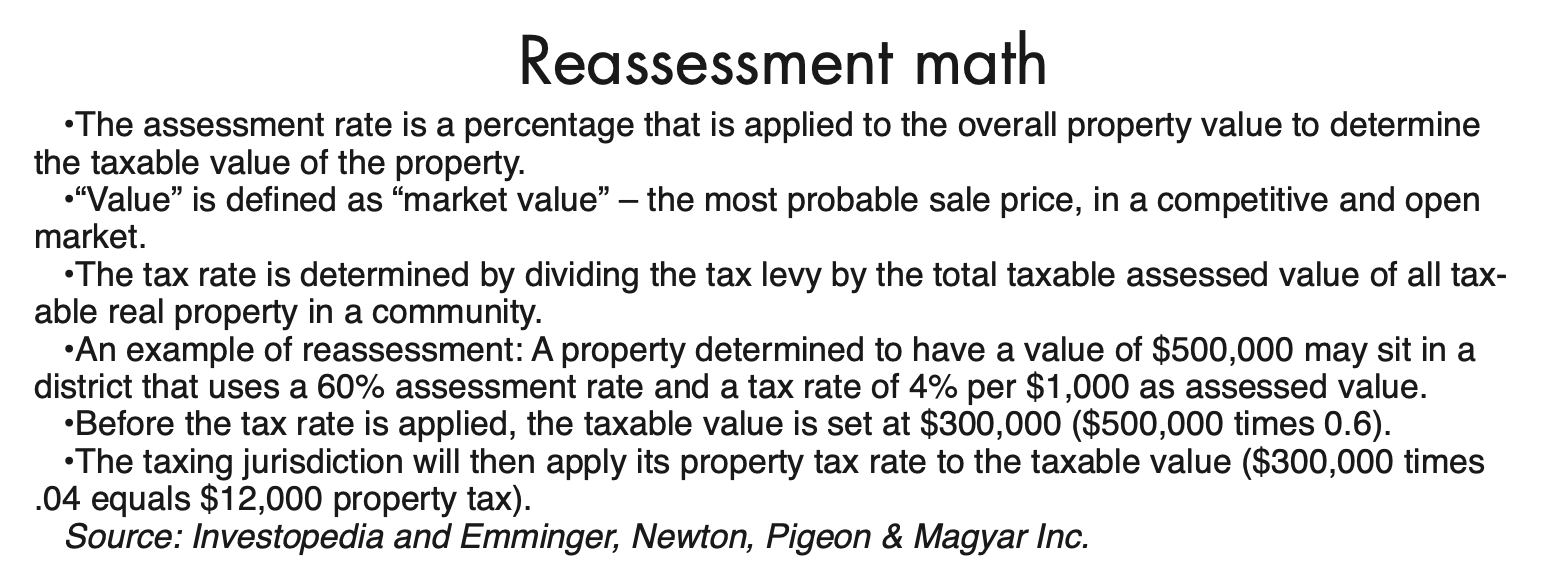
•All letters of determination following an informal review will be mailed to owners after the 2025 tentative tax assessment roll is filed on May 1.
•The preliminary 2025 assessment notification contains further advice for challenging the assessment, now that the March 21 deadline has passed for scheduling informal hearings.
•The last option residents can pursue if they believe the assessment is incorrect is to file a formal written complaint on or before Grievance Day, May 28. The officially prescribed form (RP-524) is available from the assessor or online at www.tax.ny.gov.
•Residents are advised to examine the tentative assessment role and can have discussions with representatives of the assessor’s office.
•A publication titled “Contesting Your Assessment in New Yor State” is available at the assessor’s office and online at www.tax.ny.gov.



























1859 Whitehaven Road, Grand Island, NY 14072
Phone: 716-773-7676
Fax: 716-773-7190