
+70
°
F
+74°
+58°
Niagara Falls
Thursday, 16
See 7-Day Forecast
Featured News - Current News - Archived News - News Categories
New episodes debut this week
Behind the Screens with Joshua Maloni
IG: @imjoshuamaloni
It’s hard being a print journalist in 2026.
Any person with a cellphone and a social media account can break news – and, oftentimes, the more negative or made-up the story is, the more attention it receives. Reporters, meanwhile, are working feverishly to cultivate sources and provide accurate stories that, hopefully, will inform, educate – maybe even motivate readers to take action – perhaps click that “Like” button that seems reserved for pet videos and influencer updates?
There are financial and practical challenges in running a newsroom. Advertising budgets are not what they once were due to widespread economic and cross-border struggles. Bullpens have shrunk, while multimedia responsibilities have grown.
Oh, and don’t forget about AI – that looming Skynet can write and design copy blocks in less time than it takes to have a cup of coffee in the morning.
Print journalism is daunting.
It’s often all-consuming.
And it’s … super hilarious?
Well, comedy masterminds Greg Daniels and Michael Koman seem to think so.
Daniels (“The Office,” “Parks and Recreation,” “King of the Hill”) and Koman (“Saturday Night Live,” “Late Night with Conan O’Brien”) created “The Paper” to shine a spotlight on the challenges in delivering local news, to honor local journalists … and to provide a much-cheaper and funnier form of therapy for us pencil-pushers.
Filmed and presented in the same mockumentary style as “The Office” – who can forget that other paper company, Dunder Mifflin – this sitcom is set inside the fictional Toledo Truth Teller in Ohio. The headlines here read: Once-great newspaper struggling to stay relevant, all-too-willing to chase clicks with frivolous fodder – that is, until new editor Ned Sampson (“Harry Potter” and “Star Wars” alum Domhnall Gleeson) takes the reins.
Ned is determined to bring TTT back from the brink. He takes a team of generally clueless correspondents – folks sharing building space with sanitary paper product purveyors, mind you – and coaches them to become accurate, objective, timely and engaging journalists.
“The Paper” is a heartfelt love letter to local news, a frank assessment of the newsroom’s opposition, and a genuinely funny series that every small town can appreciate.
Season two debuts Wednesday on Peacock.
Gleeson, Daniels and Koman shared more in a recent Q&A with BTS and print colleagues. An edited version is below.
WATCH:
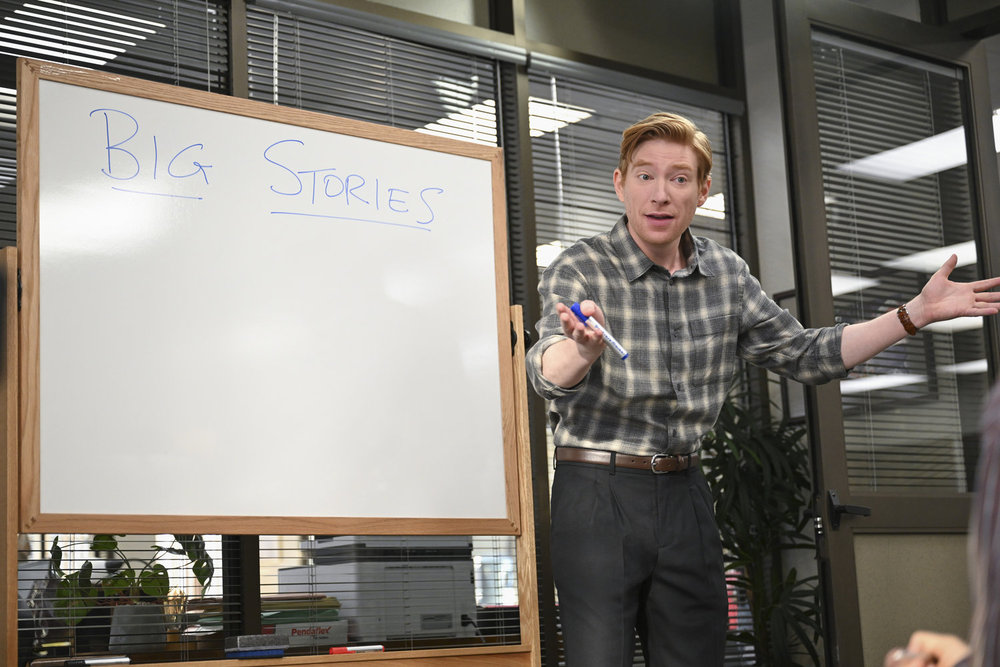
Domhnall Gleeson stars as Ned on “The Paper.” (Photo by John P. Fleenor/Peacock)
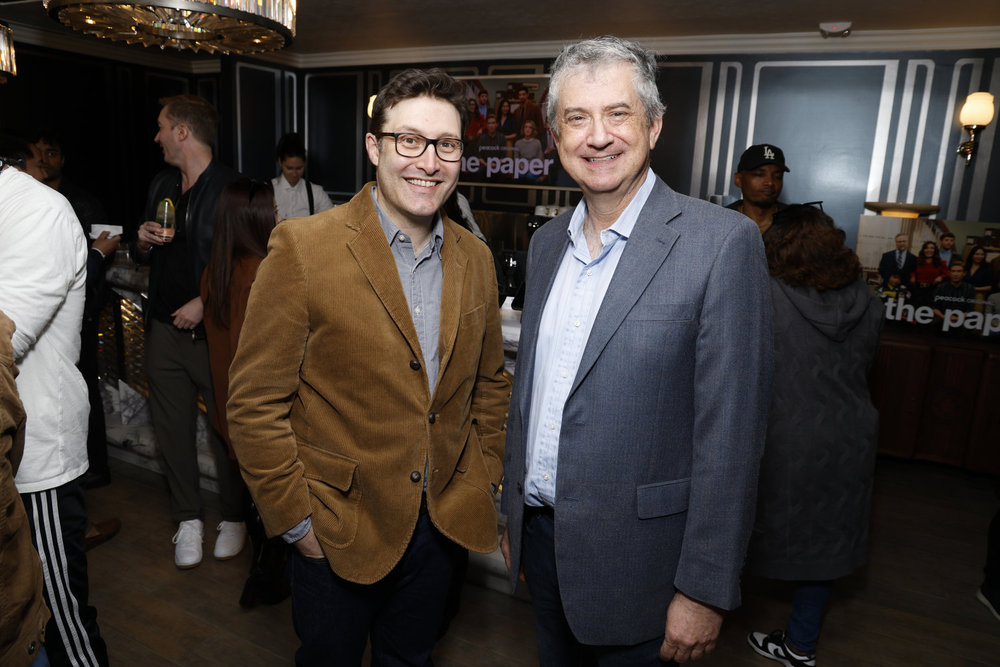
“The Paper” creators Michael Koman and Greg Daniels at the Pacific Design Center in West Hollywood on April 26. (Photo by: Griffin Nagel/Peacock)
••••••••
Q: Domhnall, you’ve worked with the biggest news outlets around the world. I’m wondering what your conversation has been like with local news outlets – particularly local newspapers – since taking on this role.
Domhnall Gleeson: The sort of feedback generally at every level, from the sort of smallest to the biggest newspapers in terms of the amount of people they’re servicing, has been absolutely amazing. Exactly what you said: People seem really thrilled that there’s something that takes what they do seriously, that understands that it matters, but that’s also an easy-to-watch thing. I think we don’t take ourselves too seriously, but we understand that journalism is a very serious thing. So, it’s actually been a really, really nice journey at every stage. It’s been wonderful.
Q: Whether in school or any other point in your life, have you ever done anything as far as a journalistic enterprise? Had you ever written an article or participated in journalism in any other way prior to this series?
Domhnall Gleeson: We had a school newspaper when I was in, like, fourth year, so when you’re 16 or whatever like that in school.
I submitted a poem to the local newspaper – I believe it was The Fingal Independent – when I was 6. I am a published poet in that way.
I’ve got about as much experience as Ned, basically!
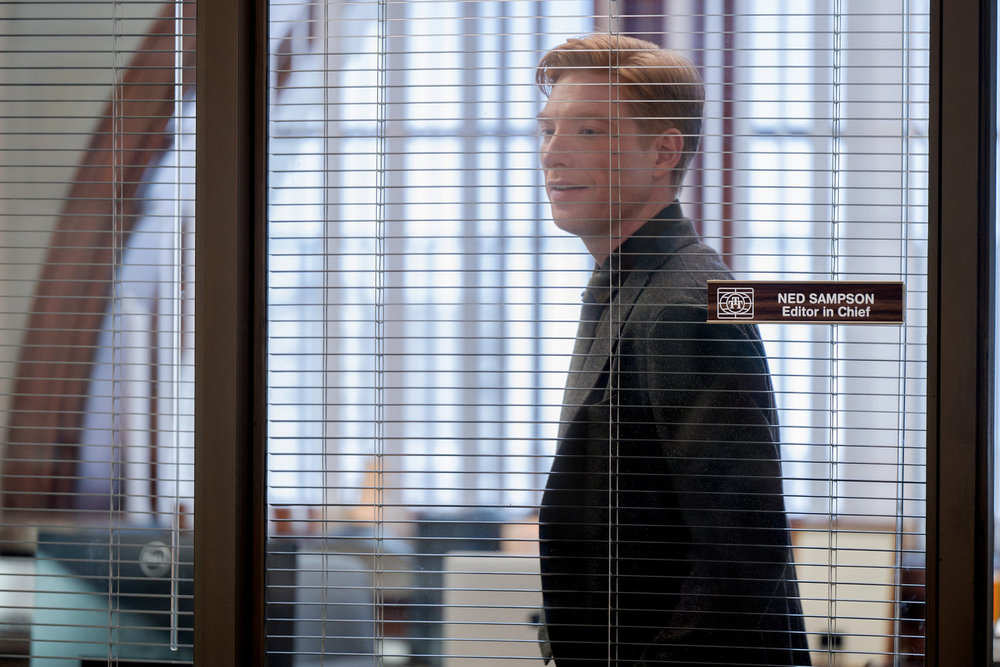
Pictured: Domhnall Gleeson as Ned. (Photo by John P. Fleenor/Peacock)
••••••••
Q: Do you hope the show encourages viewers to engage more with local news or think differently about the role it plays in their communities?
Greg Daniels: That would be great. I mean, our show is a comedy show, but it’s also a mockumentary and we were very concerned that the documentary crew that is there has found something that they want to make a documentary about. And it’s something important – it’s local news and the lack of coverage in so many communities. And Ned’s goal is to revitalize this paper, even though he doesn’t have the resources.
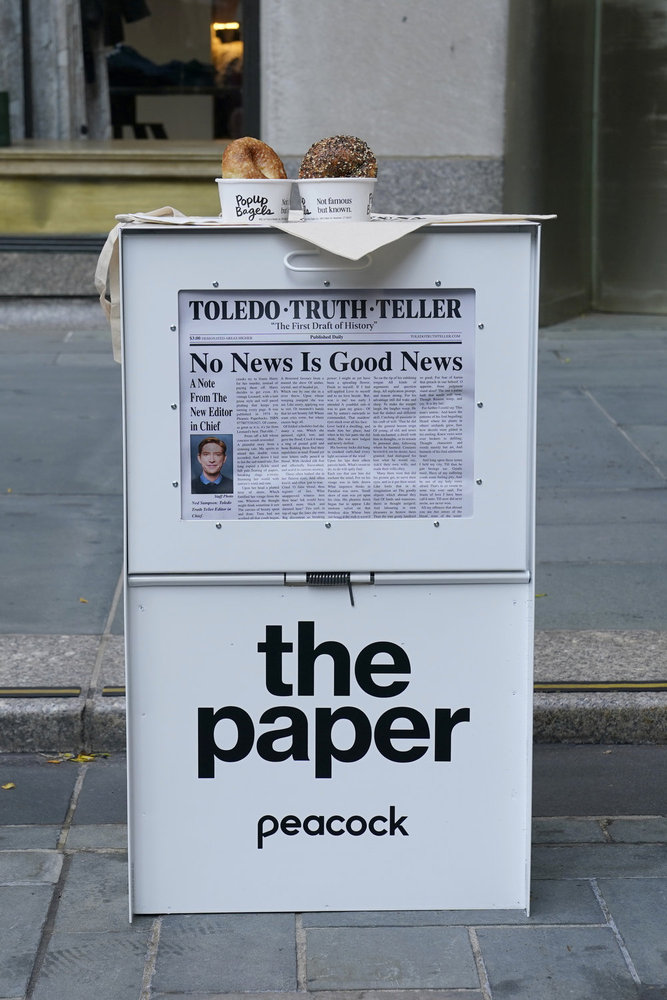
“The Paper”: “Activation,” atmospheric. (Photo by: Ralph Bavaro/Peacock)
••••••••
Michael Koman: If nothing else, if it was just a little reminder that … there are people in not every community (with local news), but the ones that are lucky enough to have it, people are trying to keep track of what’s going on in the government and their schools – and if people remember to check that out, it would be a lovely thing.
Q: What do you think the staff of the Truth Teller has that real journalists should model?
Greg Daniels: I feel like there’s a lot of optimism in the Truth Teller staff. I have a daughter who is doing high school journalism, and I did high school and college journalism. I imagine that a lot of journalists working today had the same kind of excitement when they were starting out. And hopefully the show can kind of reconnect today’s journalists with the urge that they had to get into things, which is probably being slowly beaten out of them all by economic conditions.
Domhnall Gleeson: It feels like the reality of working in journalism, there’s just a constant assault on journalism from every angle at the moment. And so, the reality of that, it will get on top of you. What the Truth Teller has is that they’re all basically brand-new to doing it this way. And so, what Greg’s talking about, that optimism, I think, that’s what makes them good at what they do, is that the reality hasn’t beaten the optimism out of them yet, which is a good thing.
Q: On working in Toledo. …
Domhnall Gleeson: I met some of the journalists from a few of the different newspapers and just young people who really cared about it and were working super-, super-hard in journalism. That’s what I loved about it. I think the show provides the humor. All I found were just amazing positivity and commitment and hard work. I found I took a lot of that for Ned.
Michael Koman: That was, to me, the nicest thing was that, when we were writing it, obviously our story has optimism in it. The best thing was, in real life, the people we met had the same feeling. I mean, I didn’t feel like anybody there was burnt out or not genuinely enjoying the fact that they got to do this every day for a living, despite the overall atmosphere and what’s happening in the country with journalism.
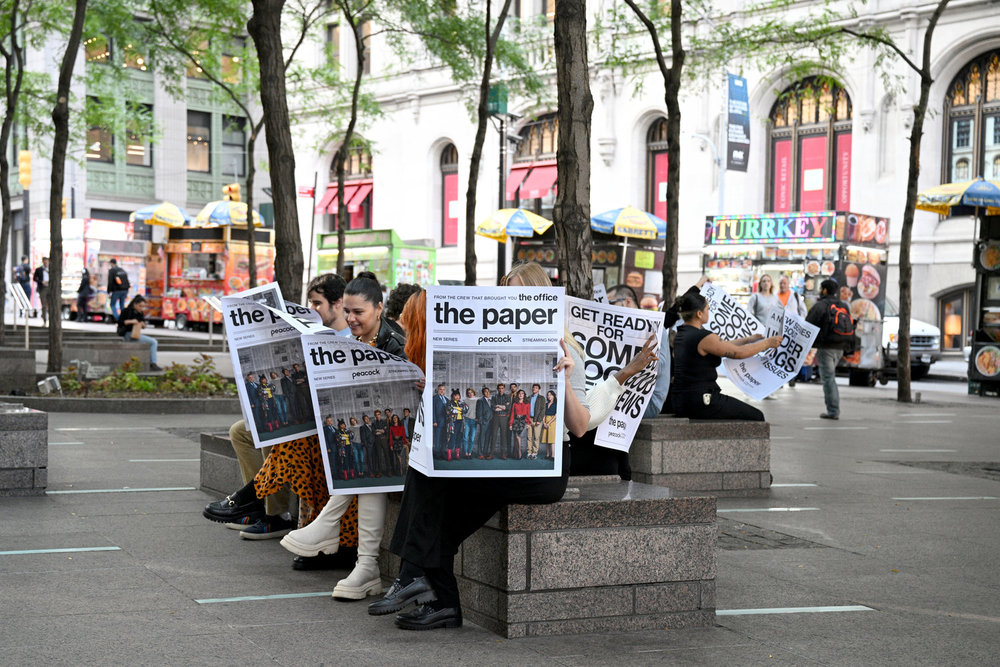
“The Paper”: “Activation,” atmospheric. (Photo by: Bryan Bedder/Peacock)
••••••••
Q: The intro to the show shows lots of uses of newspapers (wrapping, blocking windows, pet litter, food liners) – a little bit of everything. What’s everyone’s earliest newspaper memory?
Greg Daniels: I was a New York Times family growing up. My parents would spread the paper out on their bed and read it – and I wanted attention when I was a little kid, and I would roll over the newspaper and look up at them covering up the newspaper. So, maybe there’s a little bit of buried jealousy of the newspaper, sibling jealousy or something.
Michael Koman: I would get up early and go down to the end of the driveway and bring in the little plastic-wrapped newspaper and rip it open and throw every section out except the comics. I’d spread those out. What I remember the most is the ink on my hands – that I assume people still get that. But I would just get that ink on my hands and it would be on my walls and there would be many white surfaces that were impossible to clean.
But the two things: the comic section, and when I was a little older, maybe like 7 or 8, or maybe a little older, Dave Barry got syndicated in our newspaper and that was a huge deal for me. It was just the funniest thing I’d ever read.
Domhnall Gleeson: Actually, my earliest memory was about a fake newspaper. My dad did a play and the program was a fake newspaper. I think he went to see the play and then he brought the program home and I read it thinking it was a real newspaper. And in it, they were talking about some gold bug that was biting people and their arses were falling off or something like that. And I remember coming to my parents crying ’cause I was like, “What are we going to do about these bugs?” And they were like, “That is not real at all.”
That’s one of my earliest ones was dealing with fake journalism.
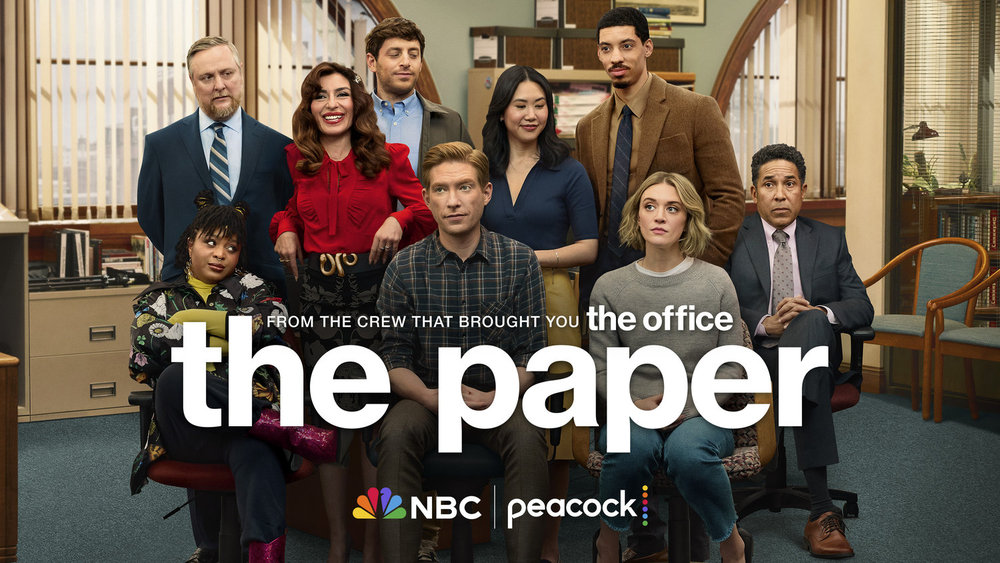
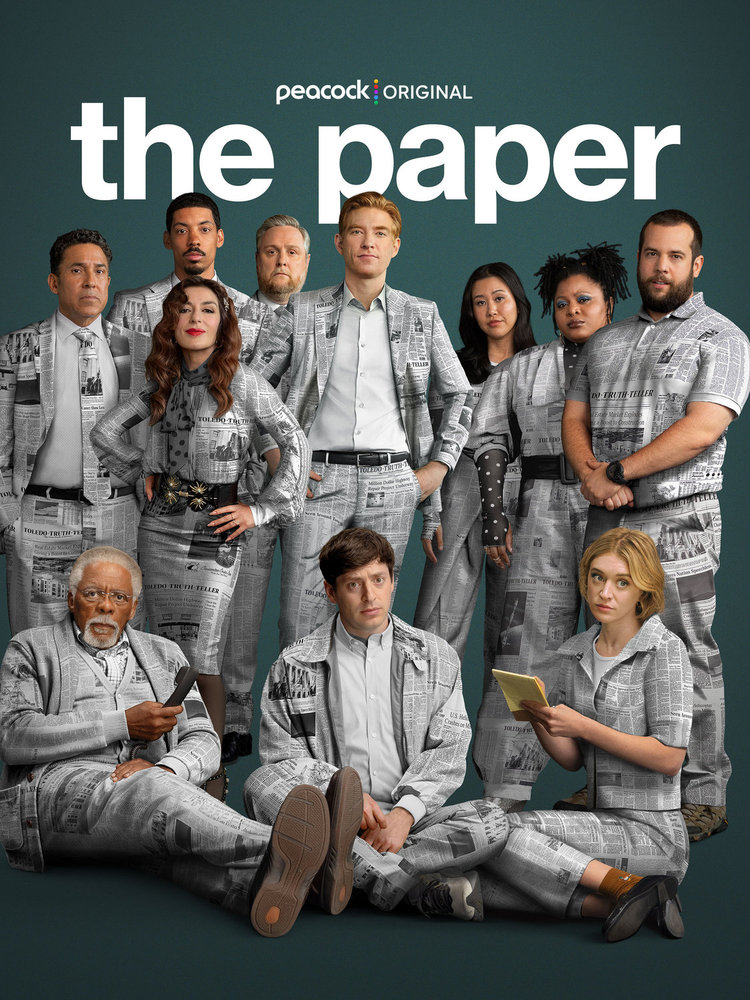
“The Paper” key art courtesy of Peacock.






1859 Whitehaven Road, Grand Island, NY 14072
Phone: 716-773-7676
Fax: 716-773-7190