


+70
°
F
+74°
+58°
Niagara Falls
Thursday, 16
See 7-Day Forecast
Featured News - Current News - Archived News - News Categories
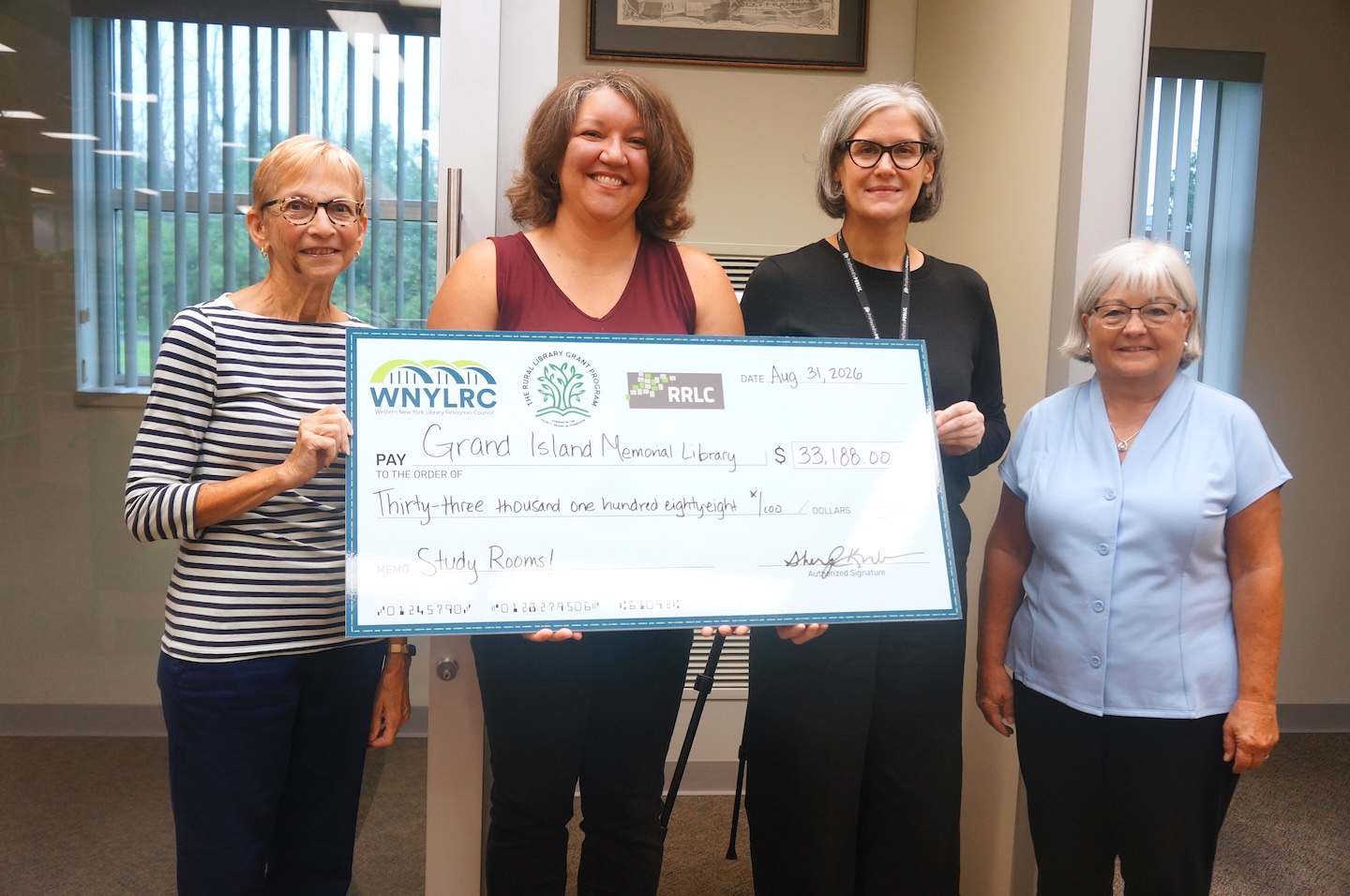
Story and photo by Senior Contributing Writer Alice Gerard
A few years ago, the hunt for a quiet space to study led a State University at Buffalo student to the Grand Island Memorial Library at 1715 Bedell Road.
“ ‘Oh, it’s great that you have study rooms here. Just so you know, the UB student population has found out,’ ” said Grand Island Memorial Library Director Bridgette Heintz, recounting the student’s words. “ ‘Just so you know, the UB student population has found out. Be prepared for a bunch of people coming in here.’
“She was not wrong. It was two summers ago when we had a waiting list going for the study rooms, for the four. So, (I felt) we need more study rooms if we can possibly do it.”
The opportunity to build more study rooms came this year when the Grand Island Memorial Library applied for grant funding from the Ralph C. Wilson, Jr. Foundation.
The funding for the project to build two new study rooms in the library came from “a Rural Libraries Grant powered by the Ralph C. Wilson, Jr. Foundation. It was facilitated through the Western New York Library Resource Council and the Rochester Regional Library Council.”
“The Foundation is providing $1.5 million in support for a three-year period (2026-28) in Western New York. The grant is being co-administered by Western New York Library Resources Council and the Rochester Regional Library Council,” said Joy Testa Cinquino, assistant deputy director of development and communications for the Buffalo and Erie County Public Library system. “For 2026, the grants awarded to WNY libraries range from approximately $1,500 to $80,000. The funded projects conform to the following interests of the Ralph C. Wilson, Jr. Foundation: youth sports and recreation, afterschool youth programming, parks and trails, nonprofit innovation, caregivers, young adults and working families, entrepreneurship and economic development and early childhood.”
In each of the three years, $500,000 will be available for rural libraries to complete projects.
On Aug. 31, representatives of the Western New York Library Resources Council presented a check for $33,188 to the Grand Island Memorial Library for the library’s newly built study rooms. There is still work being done to complete those rooms.
On Oct. 1, those study rooms are expected to become available for public use, Heintz said.
“The Council is a state-funded library system, and the library system fully provides access to different services that the library can’t do on their own. All the public libraries can get services from us, as well as academic libraries, school libraries, and our special libraries,” explained Sheryl Knab, executive director of the Western New York Library Resources Council.
“This is the first year that the Ralph Wilson was offering the Rural Libraries Grant,” Heintz said. “It’s for libraries in Western New York and libraries in Michigan. The foundation determines what’s rural, and there’s a whole metric to it. It has to be a certain population served within a certain radius of the major city.
Knab explained how the project happened: “My colleague in Rochester, Laura Schiefer, actually had the initial conversations with the Ralph C. Wilson, Jr. Foundation.
“She had the initial conversations with Katie Brisson (senior director of special initiatives for the Ralph C. Wilson, Jr. Foundation). Katie was very interested in reaching out to Laura because she wanted to do a program just for rural public libraries. And then, she brought us into it.”
Both the Buffalo area and Rochester were chosen as recipients of grant funding because of their connection to the Buffalo Bills, which Wilson owned for 54 years, from the team’s founding until Wilson’s death in 2014. It was because of that connection to the Bills that Brisson “wanted to cover Buffalo and Rochester,” Knab said.
Thirty-four libraries applied for grants in the Buffalo and Rochester areas. Of those, 25 received grants, and, of those, nine were in Erie County, Knab said.
“If libraries have a multi-year project or if they have something new they want to implement in their libraries, they can apply for three years running,” Heintz said.
The two new study rooms were needed because of the amount of use of the four existing rooms, Heintz said. “I was looking at the statistics of usage last year, and it was about 980 uses.”
Knab said the study rooms are considered to be a priority for funding: “Study rooms are becoming valuable spaces in public libraries. It’s not just an academic library issue anymore. People want to come to a public library and have quiet space in order to study or have interviews with health providers and court quietly and privately. The Grand Island Memorial Library has four already, which is impressive because they are an older library, but these two new ones are great. I understand that a student is going to be naming them.”
The two new study rooms are compliant with the Americans with Disabilities Act, Heintz explained.
Caitlin Kenney, who works for the Western New York Library Resources Council in reference and resource services, said, “I think it’s a fantastic opportunity to get some of these rural libraries the funding they need. A lot of them don’t have access to the same resources that city and urban branches do. This really helps us find different ways for them to meet the needs of their community (reference and resource services). So, I’m working with the person who’s coordinating this grant. I help oversee some of the logistics.
The funding for the two study rooms includes the cost of modular walls, tables, smoke detectors, electrical work and climate control units, Heintz explained.
“Since they’re floor to ceiling walls, this is going to be a closed-off space. There’s no ductwork in here to tie in with existing HVAC. That’s the key component I’m still working on. For now, because it’s not freezing outside, once I get chairs in here and the electrical done with lights, we should be able to open these up to the public. Once the climate control unit is put in, then this whole thing is done,” Heintz said.
“We have the frosted glass panels so that it lets light in, but there’s enough privacy for the patrons so that people aren’t actually popping in on them to see everything that they’re doing,” Heintz explained. “From the desk, I can see the outline of someone sitting in there so that I know it’s still occupied. We have sliding barn doors, which I think worked out great because it’s not something that has to swing out into the alleyway. Plus, that’s clear glass so we still get natural light from the windows. We can still see the windows from the front desk so we didn’t lose any natural light in this project.”
This is the second of two large projects being done at the library in the past few years. The other project was the installation of the Richard Earne Memorial Reading Garden.
“The space we’re standing in right now is the only unoccupied alcove where this would have made sense,” Heintz said. “The footprint of this building has three bump outs on the main library floor. Two bump outs are already occupied by study rooms. This one just made the most sense. So now, we have pretty much every square inch of possible space being used.
“So far, the response has been really positive. People are asking if they) can use it now? I say, well, there’s no light in there yet. Give me another week and then we’ll be able to open them up to the public. Because I’ve been talking to everyone about it, a lot of our regulars knew that it was going to happen. I had signage all over the place, and I put it on Facebook. I’ve gotten positive feedback from everyone so far.”
“One of the big issues is we want to make sure rural libraries knew they’re hubs, community hubs, and demonstrate that,” Knab said.
Kenney mentioned the “excitement everyone is feeling about the funding. All of the unique projects that everyone came up with are very cool. It’s clever. It’s interesting. Everyone is so genuinely grateful for being able to do this.”
The Grand Island Memorial Library’s next big event will be a book sale, Heintz said. The book sale is held in early autumn, usually in late September or early October.



















1859 Whitehaven Road, Grand Island, NY 14072
Phone: 716-773-7676
Fax: 716-773-7190