

+70
°
F
+74°
+58°
Niagara Falls
Thursday, 16
See 7-Day Forecast
Featured News - Current News - Archived News - News Categories
Story and photos by Senior Contributing Writer Alice Gerard
For Wayne West, the 25th anniversary of 9/11 holds special significance.
“For me personally, this is more than just the 25th anniversary because I was actually at the World Trade Center in 1971, a year before they opened, as an engineer to learn the peculiarities of that building,” he said. “The structure did not have pillars and columns like a traditional building of the time. The structure was actually supported by what they call an exoskeleton on the outside.
“In 1971, they said it would be able to withstand the hit of a direct aircraft because the design was done in mind with the Empire State Building that was hit when it was under construction, but they had no idea of the size and the scope of the plane (with information) that was available in 2001. If it had been a small hit or an indirect hit, it would have been fine, but something of that size with the fuel involved. It was enough to take it down.”
Thirty years later, West returned to the site where the World Trade Center stood just days earlier, this time as a member of the U.S. Army.
“On Sept. 11th of 2011, I was actually commanding an engineering unit at the Connecticut Street Armory,” West recalled. “Just by chance, the year before, I set Tuesday, Sept. 11, as an evening to bring the entire unit in for training. It was just a coincidence. We prepared and went down immediately for Sept. 11.”
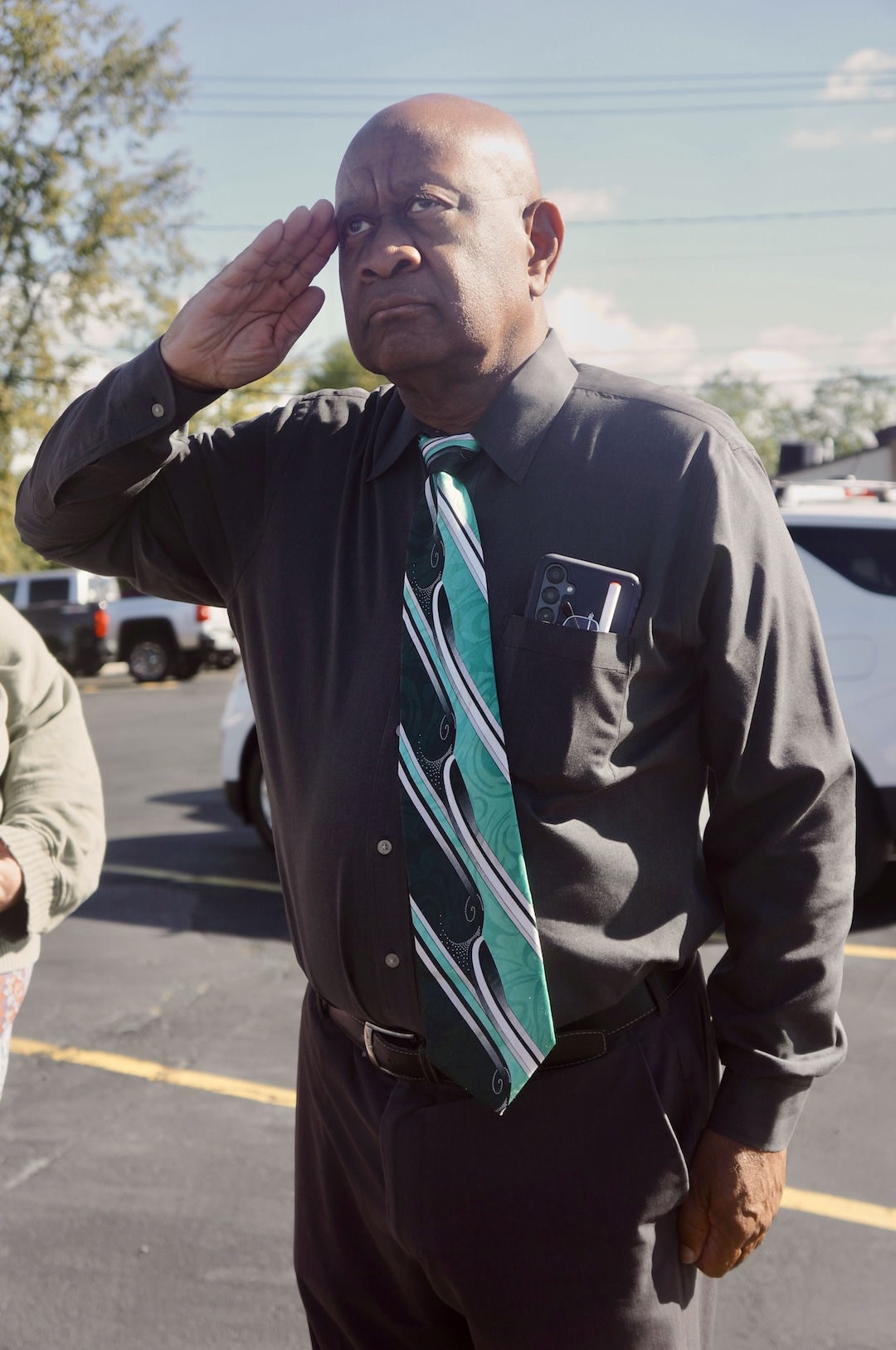
Wayne West pauses to remember the events of 9/11.
••••••••
What West saw in Manhattan was the rubble that had been the building that was designed to withstand the direct hit from an aircraft. He described the sight as “really devastating.”
The twin towers “did implode,” West said. “Again, it was devastating watching it. Me being there a year before it opened and (30 years later) watching it as we were sifting through the rubble. I remember walking past a parking lot for the center and thinking, ‘How many of these cars are never going to see their owners again?’ The debris was on top of those vehicles.
“My unit was an engineering unit that’s charged with creating a base camp or a small town. It meant that I had the ability to provide assistance to the local area in all areas that a town would require: power generation, water purification, search and rescue, medical support – the whole bit. Initially when we got down there, the powers that be thought they were getting too many volunteers, and they wanted to turn us back. I said, ‘I’m your one-stop shop. We can do just about anything you need. I can augment your hospitals. I can provide power generation where it’s needed in emergencies.’
“We ended up opening up at a small island off of Manhattan, called Governor’s Island, a former Navy base, and we used that for a command and support structure for the entire operation.”
Twenty-five years after the events of 9/11, West paused to reflect during the 9/11 ceremony at the Charles N. DeGlopper Memorial VFW Post 9249 about the day 25 years earlier.
“We always think of the World Trade Center as two buildings. The Twin Towers. In actuality, we had five adjoining buildings around it,” West said. “Also, the attack on the Pentagon and the thwarted attack in Pennsylvania, which we also forget sometimes. Many of my friends, people that I met in New York City with the fire departments and the police departments and first responders, and some of my soldiers have since lost their lives because of complications from the smell and the dust and the contaminants of the debris that was down there. I literally don’t go for a day without thinking about that. Sleeping in dust that was an inch thick.”
West described that day and the time that followed as one of the biggest life-changing experiences in his lifetime.
Christian Eshelman, former commander of the VFW post, said, “I was not in the military during 9/11, but 9/11 did inspire me to join the military, so I could be in a position to protect those back home and be deployed to keep the war fought overseas, instead of in our country. I felt very unprepared to do anything. The military, I felt at the time, offered me a chance to do something. Not necessarily just to go and fight, but to help out the country in general. I was in the Air Force, and I did air transportation. I helped deploy troops not only to national emergencies, but in and out of the war and cargo and everything in the supply chain.”
Eshelman’s service took him to Iraq, Afghanistan and Qatar.
After 25 years, Eshelman said his memories of the day’s events were that “as a nation, we’ve come a long way and we’re now seeing the generation that fought the war following becoming the next wave of veterans needing assistance and benefits. It’s important that people come out and support veterans service organizations like the VFW and the American Legion so we can really take care of those who have been protecting the country.”
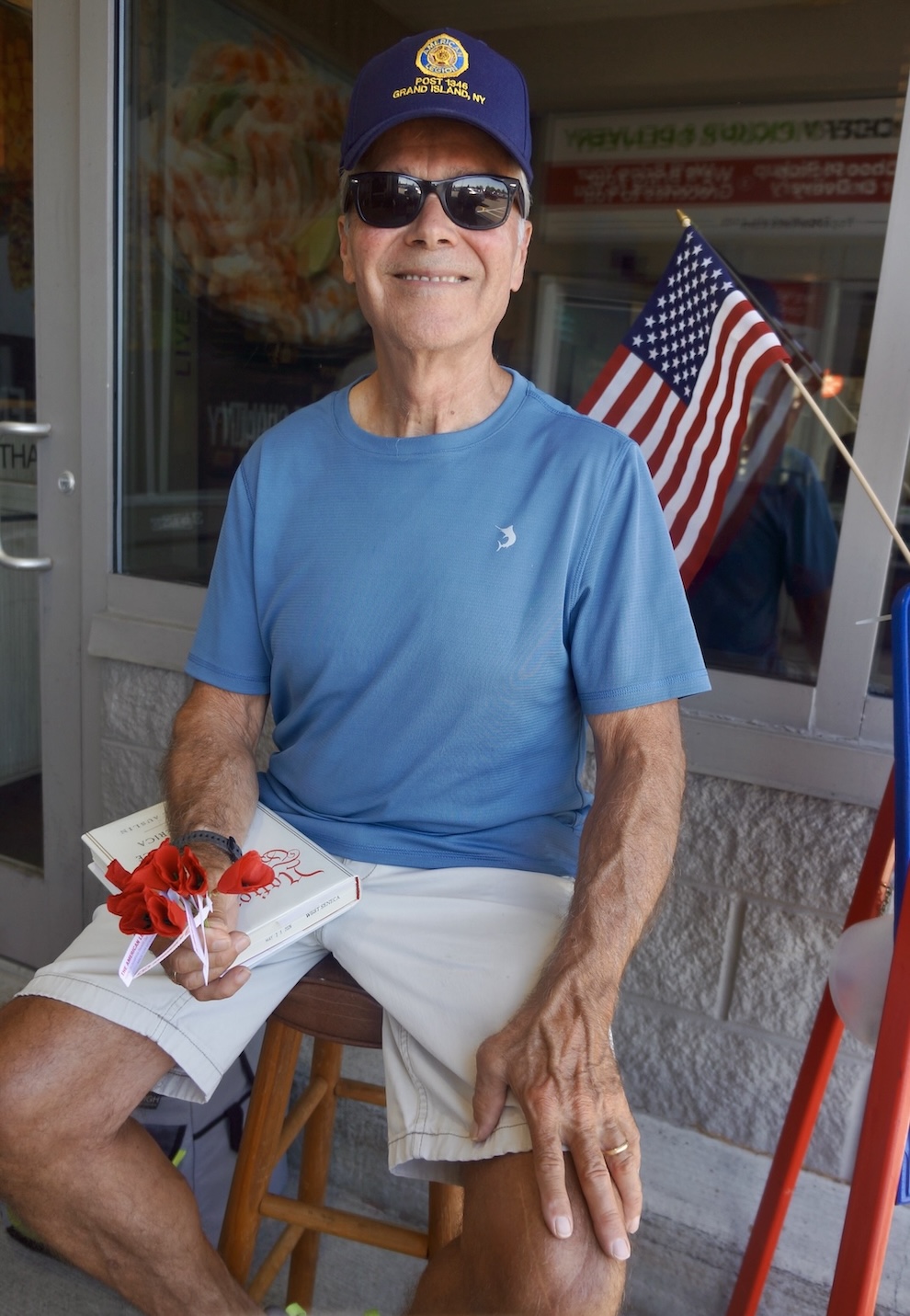
Dan Brown looks for donations to the American Legion, as well as people to wear a red poppy.
••••••••
Dan Brown, who was offering poppy pins at Tops Friendly Markets in exchange for a donation to American Legion Post 1343 on Sept. 11, recalled his experiences when working as an administrator at the Veterans Administration Hospital in Buffalo on 9/11.
“I was working on the eighth floor of the VA Hospital in Buffalo,” Brown recalled. “Somebody came in and said, ‘You’ve got to watch this.’ We walked over to one of the inpatient units in the day room. They had a TV on, and we watched that. At first, we thought it was just an airplane that inadvertently crashed. When the second plane crashed, we knew it was terrorism. My first thought was, ‘I better call my reserve unit -because I was in the Air Force Reserve in Niagara Falls – and see if they needed me there. So, some of our reserve member friends were volunteering to go work up there for the week. They probably needed people. They didn’t need me right away, so I didn’t go in.
“We were all just appalled at what happened. There were flags out everywhere. I had some visitors from New Jersey that visited me. They were going to drive to New York City that day and they couldn’t because of what was happening, so they decided to come to visit me instead.
“It was a very eerie feeling to have no planes in the air. They grounded all the airplanes. Everything was quiet. It was eerily quiet.”
Brown had several deployments prior to 9/11, including Egypt in 1993 and Bosnia in 1997-98.
“My job (in Bosnia) was to arrange for medical crews on cargo planes to pick up patients and fly them out of war zones,” he said. “One of the most interesting places I was at was I was called to go to Egypt, knowing that I would have to go down to Somalia. Egypt was quite an interesting place, but Somalia was a like a war zone down there.”
Following that, he was sent to Germany and, in his post 9/11 deployment in 2013, Brown was given a command in Afghanistan.
“It was the summertime,” he said. “It was extremely hot. I was in charge of 120 people, where we would stage patients and also new patients. It was interesting. There were a lot of locals that worked on the base, so I had a chance to meet some of the Afghanis. They were very friendly people.
“I was there for about four and a half to five months. It was a good experience. We were living in air-conditioned tents, but it was very hot. It was over 120 degrees outside. There were things to do. The military always sets up gyms and rec centers for people to go to. There were a lot of movies you could rent on DVD and books to read. There’s the American Red Cross over there that’s always giving out things. People donate all kinds of things. One of the most interesting things the American Red Cross would do is deliver all of this mail from school children. These were first- and second-grade kids that would make greeting cards for us, addressed to any service man or woman.
“It was just nice, thanking us for our service and this kind of thing. But it was very rewarding, and I would do it all over again.”
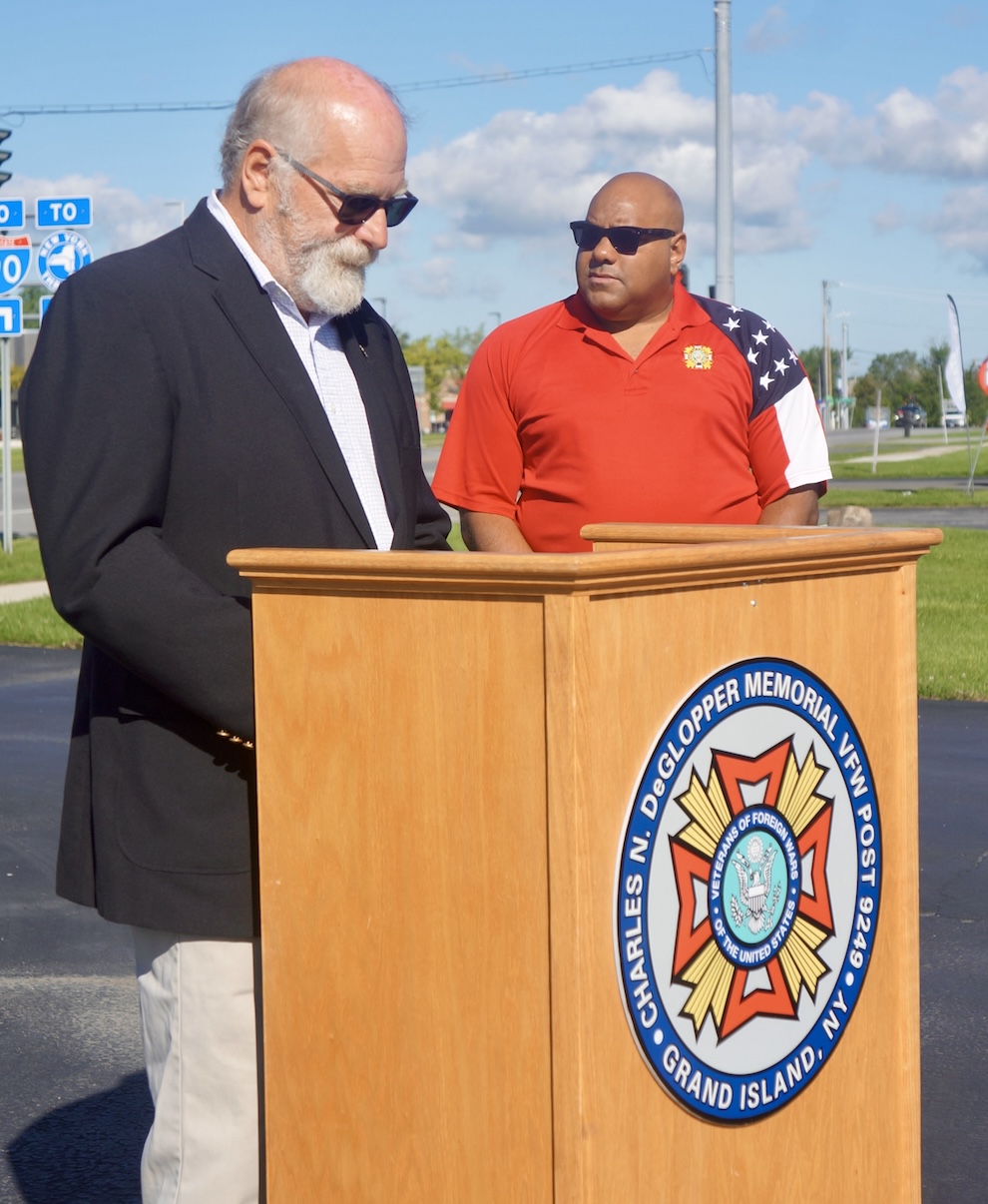
Town Supervisor Peter Marston speaks at the VFW’s 9/11 ceremony about his experiences visiting Ground Zero. Next to him is Christian Eshelman, former post commander.
••••••••
Town Supervisor Peter Marston, who spoke at the 9/11 ceremony, shared some of his memories of having visited Ground Zero.
“I vividly remember the church that was located in the backdrop, that was used as a staging area for the rescue efforts as the tragedy unfolded. That church is still there today,” he said. “The experience of being there in person is difficult, if not impossible, to explain in words. It was an area of remembrance. It was a location of massive destruction and loss of life. It’s an area now where friends and families go to remember their loved ones who lost their lives on that tragic day. Surviving parents, spouses and children of victims continually at the site, leaving pictures, flowers and small keepsakes.
“This was pretty touching to me. I witnessed one woman leave a small, black coffee next to a name on the wall, obviously paying homage to someone she had lost. This is, by far, one of the most moving places that I have ever visited. Being there rekindled all the emotions I remember feeling 25 years ago. If you ever get the opportunity to visit over there and pay your respects, please go. You won’t regret it.”
West asked people to never forget the human toll associated with 9/11: “I would just ask people to keep the families of the fallen in their prayers and their thoughts. Just remember that there were more than the 3,000 people who were lost on that single day. The loss continues, even through today. We’re finding cancer and things we didn’t know existed because of the destruction on that day.”
When asked what he would tell young people about 9/11, West said, “I think, for me, it reminds me of my father telling me about Pearl Harbor and World War II in a similar sense. This country has been founded with a concept called ‘manifest destiny’ going from shore to shore. In doing that, we have two protective barriers that a lot of other countries don’t have. So, the oceans have provided us tremendous support and defense over the 250 years of our existence. But this, Pearl Harbor, the War of 1812, were times when we actually experienced pain and destruction on our own soil.”
Eshelman reflected on what he would tell young people: “Hopefully, they never experience anything like this. It seems that every generation has a tragedy that defines it. Hopefully, they don’t have an event. Don’t discredit what generations previously have gone through and learn from history.”
Brown said he would tell young people, “Go to the library and get a book. Read up on it. Watch videos. Consider the military as a steppingstone to a good job or a possible career.”












1859 Whitehaven Road, Grand Island, NY 14072
Phone: 716-773-7676
Fax: 716-773-7190